
Give two households identical debts, identical incomes and identical spare cash, and they can still clear their balances years apart. The difference is the order they pay things off in, and how long they keep going.
The debt payoff calculator models both.
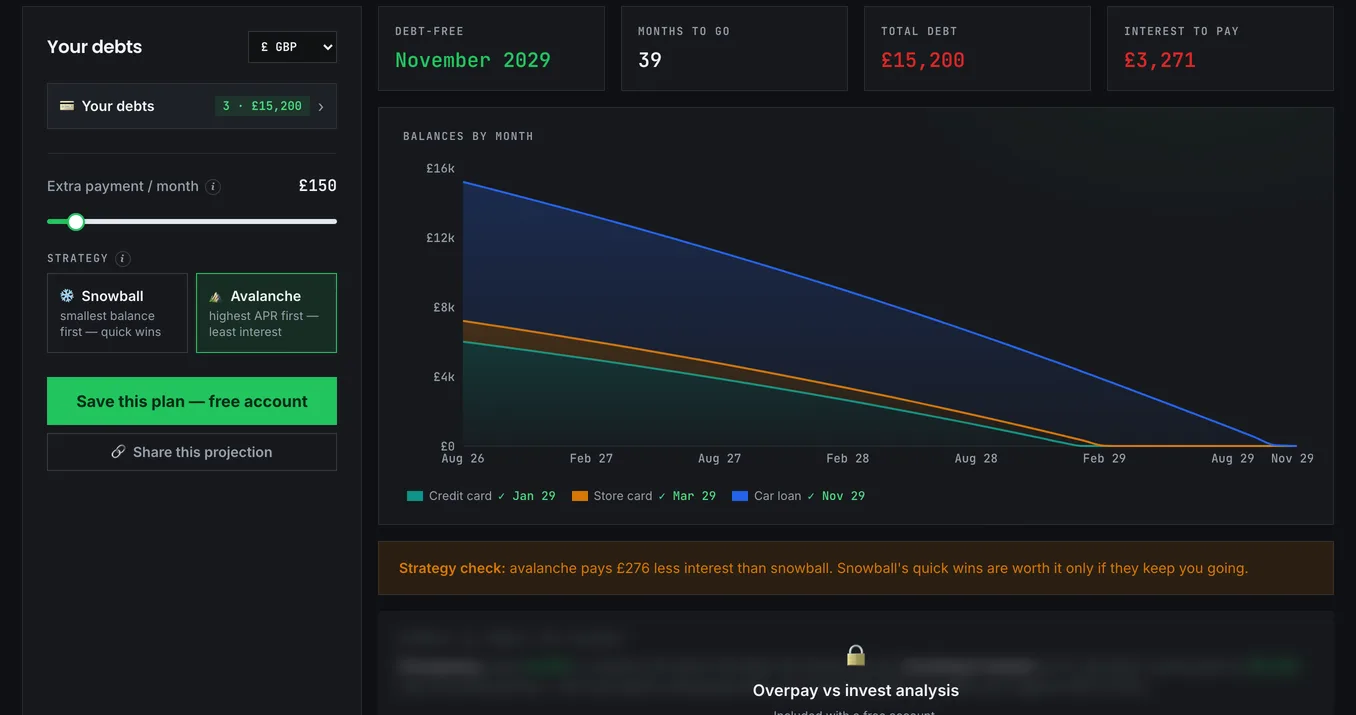
Entering your debts
Each debt needs three figures: the balance outstanding, the APR, and the minimum payment the lender requires.
Get the APR from the statement rather than from memory. People routinely misremember a store card at 22% when it is 39.9%, and that gap changes which strategy wins. For credit cards the minimum is usually a percentage of the balance with a floor; take the number from your most recent statement and it will be close enough.
Add everything that charges interest: cards, store cards, overdrafts, personal loans, car finance. Leave the mortgage out. It behaves differently, the rate is an order of magnitude lower, and overpaying it is a separate decision handled by the mortgage overpayment calculator.
An interest-free balance transfer sitting at 0% goes in at 0%, but note the date the promotion ends, because the calculator assumes whatever rate you give it lasts. Variable rates move, and a 0% period expiring is not something the projection knows about. That one catches people out, because the plan looks fine right up to the month the real rate arrives.
The extra payment
This is the only lever you control directly, and it does almost all the work. It is the amount above the combined minimums that you can put toward debt each month. Be realistic rather than aspirational: a figure you can sustain for three years beats one you abandon in month four, and the projection is worthless if the input was a wish. If you do not know what is genuinely spare, the payday allocator splits a month's income into commitments and what is actually left over.
Before committing every last pound of it, settle two questions. Is there an emergency fund? Clearing debt with every spare pound and then meeting an unexpected £600 bill with the same credit card is a loop, not progress. Even a small buffer breaks it, and the emergency fund calculator sizes one against your actual outgoings. And is the employer pension match being taken? A 100% match is an immediate doubling that no consumer debt rate comes close to, so paying the minimum on a 20% card to capture a 100% match is arithmetic, not a close call. Beyond those two, high-interest debt is usually the best available return you have anywhere. Clearing a 24% card is a guaranteed 24%, which no investment offers and none guarantees.
Snowball or avalanche
Avalanche targets the highest APR first. It is mathematically optimal: it always pays the least total interest and it is always at least as fast.
Snowball targets the smallest balance first. It costs more, sometimes considerably, and it clears individual debts sooner, which produces visible wins early.
The calculator shows both, and the Strategy check underneath states the actual cost of choosing snowball with your numbers: something like avalanche pays £276 less interest than snowball.
That figure is the whole decision. If the gap is small, a few hundred pounds over three years, pick whichever you will actually stick to. For many people that is snowball, because watching a debt disappear entirely in month five is motivating in a way that a marginally lower interest total is not, and the best strategy is the one you finish. A plan that is 4% less efficient and gets completed beats the optimal plan you quit in month eight. If the gap runs to thousands, that is real money, and the case for avalanche gets much harder to argue with.
The date, the interest, and the chart
Debt-free date assumes you keep paying the same total every month, rolling each cleared debt's payment onto the next. That rolling is the engine of both methods; without it neither works. Months to go is the same answer as a countdown.
Total interest is what the debt costs you across the whole run. Watch it as you move the extra payment slider, because the sensitivity is greater than people expect: on the calculator's default debts, another £50 a month finishes five months sooner and takes £486 off the interest, since you are also cutting the time interest has to accrue.
Balances by month draws each debt separately, so you can see them retire one at a time. Under snowball the lines end in size order; under avalanche they end in rate order, and a large low-rate debt can sit almost flat for a long time before it finally moves.
The whole projection takes two things on trust: that you add nothing new to any of these balances, and that every minimum is met. If a card is still in use, the model and your life diverge immediately, and the model will look wrong when it is your spending that changed. Miss a minimum and fees and penalty rates apply that no projection accounts for.
Saving your plan
Signed in, Save this plan keeps it on your dashboard with the debt-free date visible. Coming back to update balances as they fall is worth doing; watching the date move closer is the most reliable motivation the tool provides.
Without an account the calculator works in full. Nothing is stored, so use the share link to keep a copy of the scenario.
When the answer is not a spreadsheet
If the minimums alone exceed what you can pay, no ordering strategy fixes that, and this calculator will not tell you anything useful. That is a situation for free debt advice. StepChange, National Debtline and Citizens Advice all offer it in the UK, none of them charge, and the FCA's consumer pages are a good map of what regulated help looks like. Getting help early is considerably better than getting it after defaults have landed.
For everyone else, the value here is narrow and real: it turns a vague pile of balances into a date. Having a date changes how the next three years feel.