
Save £1 in week one. £2 in week two. Keep climbing, one pound more each week, until £52 goes in during the final week, and the total after a year is £1,378.
The 52-week challenge is the least sophisticated tool on this site and one of the most effective, for a reason that has nothing to do with arithmetic. It turns saving into a game with a visible board, and ticking a box is a much better motivator than intending to save.
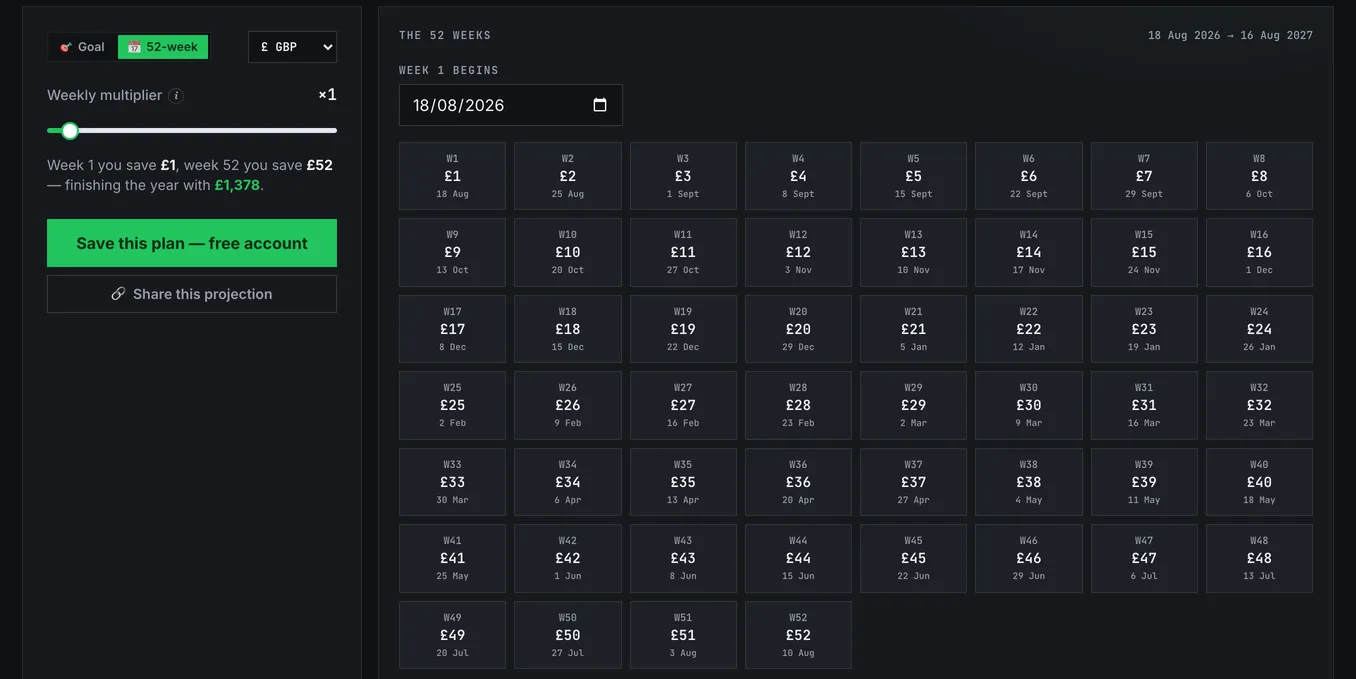
Pick a start date, and probably not January
The challenge runs against real calendar dates, not abstract week numbers. Choose the date you are actually starting and each week gets its own dates, so "week 23" is a specific week in your year rather than a number you have to translate.
January is the obvious choice and not the best one. Start then and the largest payments, £45 to £52 a week, land in November and December, which is precisely when money is tightest. A very large number of January challenges die in the last six weeks for exactly this reason. Starting in March instead pushes the expensive tail into January and February, clear of the Christmas squeeze entirely. And if your heart is set on January anyway, run the whole thing backwards.
Climbing up or counting down
The standard version climbs from £1 to £52. Easy at the start, hard at the end. It's the right shape if you expect your income to rise during the year, or if you need the early weeks to be effortless while the habit takes hold.
The reverse starts at £52 and falls to £1. Difficult immediately, easier every week, which is why it suits anyone starting in January, and it carries a genuine advantage besides: the money is invested earlier, and the weeks you are most likely to quit are the cheap ones at the end. The total is identical. The failure profile is not.
£1,378 may be too small to matter or too large to sustain, and both problems have the same fix: multiply the whole thing. Doubling gives £2,756 a year, peaking at £104 in the final week. Halving gives £689 with a gentler peak. The structure is what does the work, not the specific amounts. If it's the top end that worries you, cap it instead. Running £1 to £30 and then holding at £30 for the remaining weeks still saves over £1,000 and removes the cliff entirely.
Working the grid
Tick each week as you pay it. The grid shows completed weeks, the current week and anything overdue, and the grid is the whole product. A savings plan you cannot see the shape of is an intention; a board with 52 boxes and 19 of them filled is a streak you do not want to break.
Don't wait for a perfect week to start, and don't restart from week one after a miss. The number that matters at the end of the year is the total saved, and a challenge with three missed weeks that finished beats a perfect challenge abandoned in April by a considerable margin.
Most completed challenges have the same three habits behind them. The payment is automated, because a standing order for the right amount each week removes the decision entirely; some people set a monthly transfer covering four or five weeks at once instead, which is less satisfying to tick and far more reliable. The money sits in a separate account, because money in your current account is spending money regardless of what you have labelled it, and a named savings pot makes withdrawing it a decision rather than an accident. And the pot has a job decided in advance. "Savings" is a weak destination; "Christmas without a credit card" or "the excess on the car insurance" survives contact with a tempting Saturday. If it is a specific target, the savings goal calculator will tell you whether £1,378 actually gets you there or whether you need the doubled version.
If the ramp doesn't suit you
The escalating grid is the classic, but the same board runs several other schemes. Flat weekly is the dullest and the easiest to automate: £26.50 every week reaches the same £1,378 with no cliff at either end. Round-up saving takes the change from every card payment rounded to the nearest pound, and you tick the week off once the total clears that week's target; many UK banks will do the rounding automatically, and the unpredictable amounts are motivating to some people and impossible to plan around for others.
You can also tie the board to behaviour rather than dates. Pair it with a rule that any day you spend nothing on wants adds £5, which links the saving to something you did rather than a week that passed, and pairs naturally with the no-spend day count in the Expense Diary reports. Or play pick-a-number, the most forgiving variant and the one most likely to be finished: each week, tick off any unclaimed square you can afford. Flush weeks clear the expensive squares, tight weeks clear the cheap ones, and the year still totals £1,378.
What the £1,378 is actually for
This is a habit-building tool. Its output is a year of consistent saving and the discovery that you can do it, which is worth more than the £1,378 to most people who complete it.
It is not an investing strategy. The money sits in cash, earning at best something near the Bank of England's Bank Rate, and for a one-year horizon that is exactly right. Whatever interest it earns will sit comfortably inside the personal savings allowance for most people, so there is no tax to think about either. Just don't let a completed challenge harden into a permanent cash pile; once the year is done, decide where the money should actually live. Nor is it a substitute for an emergency fund. If you have no buffer at all, sizing one properly with the emergency fund calculator is the more urgent job, and the challenge is a perfectly good way to build it.
And if £1,378 a year is a meaningful proportion of what you can save, the more useful long-term question is what a consistent monthly amount compounds into over decades rather than one. The compound interest calculator answers that, and the numbers over twenty years tend to surprise people who have only ever thought in single years.
Most people who finish do one of two things: run it again at double, or convert the final week's amount into a permanent monthly standing order. Both are good outcomes. The point was never the £1,378. It was proving to yourself that money leaves your account on a schedule without you noticing, which is the mechanism behind every larger financial goal you will ever set.