
"Save for a house deposit" is not a plan. "£380 a month for 41 months" is. The savings goal calculator makes that conversion concrete: a target, a monthly amount, and the date the two meet.
Two directions through the same sum
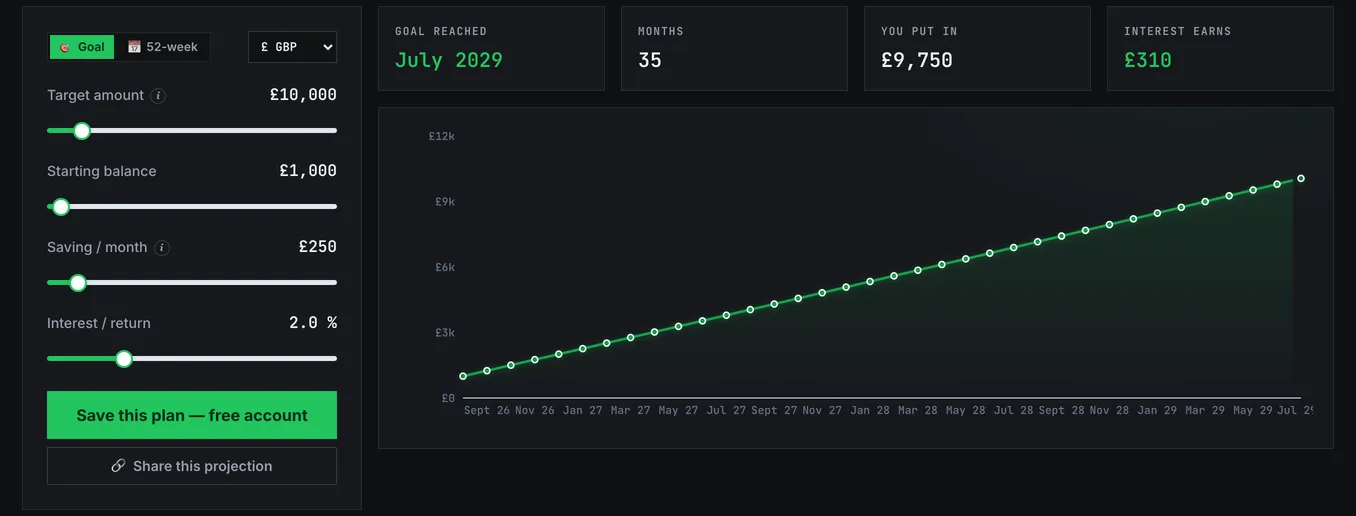
The calculator's native direction is "when". Enter the target, what you already hold, and a monthly amount you know you can manage, and it returns the date the goal is reached and the months remaining. The other direction, how much a month for a deadline, is a few nudges of the same slider: move the monthly amount until the reached date lands on your date, and the number under your finger is the answer. Cruder than a solver, and more informative, because you watch the date move as the amount changes and the trade-off stays visible.
The "when" direction is more useful than it sounds, because it produces answers you can act on. "£720 a month" prompts despair. "£250 a month reaches it in September 2030" prompts a decision about whether that timing works.
Getting the target honest
The target amount should be the real, all-in figure, and this is where goals quietly go wrong before any saving has started. A house deposit is not just the deposit: legal fees, survey, moving costs and stamp duty are part of the same event. Buying a car includes insurance, tax and the first service. Weddings famously come in above their budget. Add the extras now, because discovering them at the end is how goals get missed by three months.
The amount already saved is whatever is earmarked for this specific goal, and your emergency fund does not count. It has a job already, and this is not it.
The deadline you hold the answer against wants realism rather than optimism. A goal you miss by six months because the deadline was invented is demoralising in a way that a longer honest deadline is not.
And the interest rate is what the money earns while it waits. On short goals this barely matters, and you can leave it at zero without meaningfully changing the answer. Beyond about five years it starts to do real work, which brings up the one decision the calculator cannot make for you.
Cash, invested, and the awkward middle
The time horizon settles it. Under three years, hold cash. A house deposit needed in eighteen months has no business in the stock market, because a 20% fall the month before you exchange is not a temporary paper loss; it is the purchase not happening. Use a savings account, or a cash ISA if you have allowance. Between three and five years, still mostly cash. Markets usually recover in that window, but "usually" is doing a lot of work when the money has one specific job on one specific date. Beyond five years, invested is reasonable: the growth becomes meaningful enough to matter and there is time to recover from a fall. This longer range is where the interest rate field earns its place, provided the figure is realistic, since entering a nominal return against a real target quietly understates what you need.
Match the risk to the deadline, not to the return you would like. The cost of being wrong on a short goal is the goal itself.
When the monthly figure is impossible
It happens constantly, and the honest responses are few. Extend the deadline, the most common fix and often the correct one; six extra months can cut the monthly figure by a fifth. Lower the target, remembering that a £30,000 deposit and a £24,000 deposit are different mortgages, not different lives, and it is worth checking what the smaller figure actually costs you: sometimes a slightly worse rate, sometimes nothing at all. Find the money, not from willpower but from structure, because the subscription audit and a look at the wants share in the 50/30/20 budget planner usually surface more than a month of trying harder does. Or accept it will not happen on that timeline, which is genuinely a valid answer, and better than three years of failing at an impossible target.
Several goals at once
Most people have more than one running: a holiday, a car replacement, a deposit. Give each its own pot, because one pile of savings with three purposes gets spent on whichever feels most urgent, and the sinking funds tool is built for exactly this, holding several targets side by side with their own dates. When money is tight, sequence rather than parallelise. Three goals funded at a third of the required rate each means missing all three, while finishing one and moving its contribution to the next is faster and much more motivating. The payday allocator helps split each month's income across goals once you have decided the order.
The standing order does the saving
The single change that most improves the odds of hitting a goal has nothing to do with the calculator: a standing order for the day after payday. Money that moves before you have looked at your balance is saved. Money you intend to save at the end of the month competes with everything that happened during it, and loses often enough to matter. That is the whole of "pay yourself first", and it survives being a cliché because it works. The day-after timing is deliberate, too. Pay dates drift around weekends and bank holidays, and a standing order that bounces because it beat your salary by four hours is an annoying way to break a streak. If your income varies, set the transfer at the level of a poor month and top it up manually in good ones; a transfer you have to cancel twice a year does more damage to the habit than a smaller one you never think about.
Where the money sits matters almost as much. For a first home, the Lifetime ISA adds a 25% government bonus on up to £4,000 a year, an immediate £1,000 that no interest rate matches. Its restrictions are real: you must be 18–39 to open one, the property must be under the price cap, and withdrawing for anything other than a first home or age 60 carries a 25% penalty that takes back more than the bonus gave. For a deposit specifically it is usually the best available option; for a goal that might change, it is a trap worth understanding first. For everything else, a cash ISA shelters the interest from tax, which matters more now that rates are higher and the personal savings allowance covers less than it used to. GOV.UK's ISA guidance carries the current rules and limits for both.
Signed in, the goal saves to your dashboard with its progress and date, and updating the saved balance every month or two is the whole trick. A target that is 40% complete pulls you forward in a way that a target you have not looked at since January does not. And if the goal is an emergency fund, size it properly first: the emergency fund calculator works out the target, and this tool turns it into a schedule.