
Find an extra £100 a month and point it at your mortgage. Then watch what it does, because the effect is quietly dramatic: the money comes straight off the capital, every future month's interest is calculated on a smaller balance, and the saving compounds for the rest of the term.
The mortgage overpayment calculator puts numbers on it.
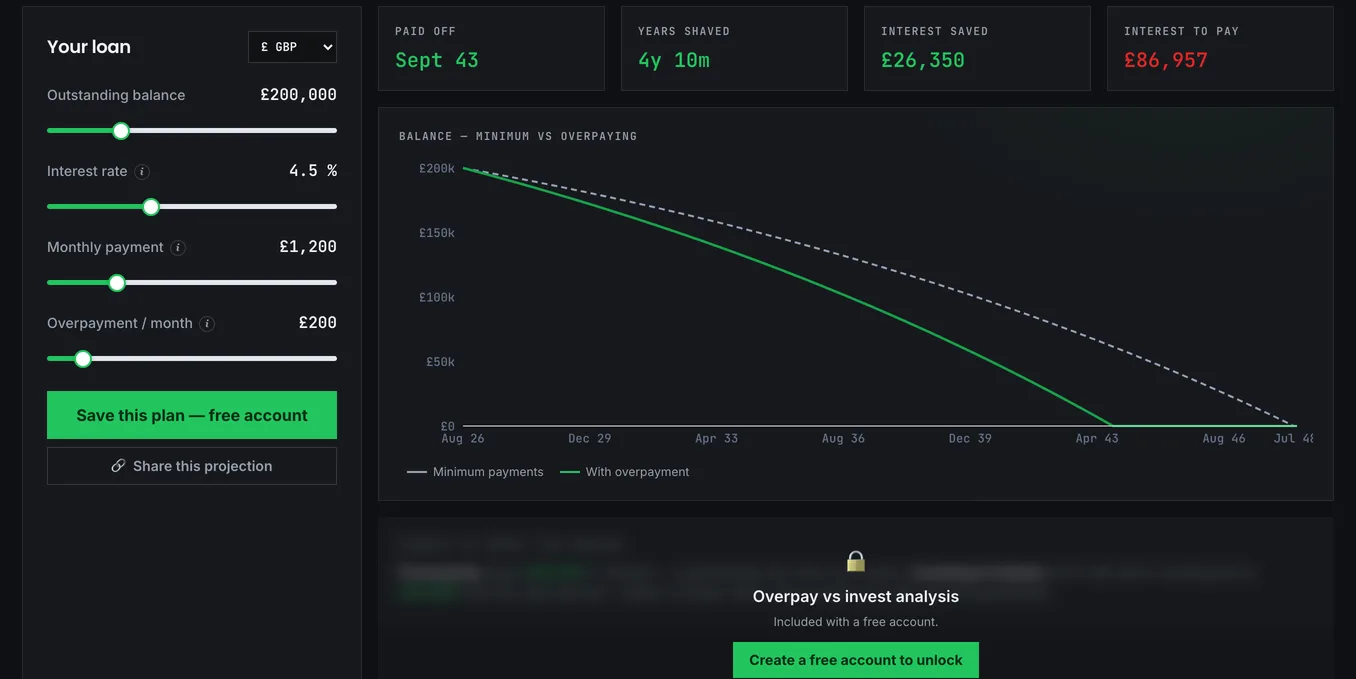
What to enter
Outstanding balance is what you owe today, not what you originally borrowed. It is on your annual statement or in your lender's app.
Interest rate is your current rate, and it deserves a moment's honesty. If you are on a fix, this is the number that will change at renewal, and what it changes to depends on the market, the Bank Rate at the time, and your loan-to-value. So the projection is most reliable over your current fixed period and progressively more speculative after it; a twenty-year projection built on today's rate is a sketch, not a schedule.
Monthly payment is your normal contractual payment. There is no separate term box: the calculator works the remaining term out from the balance, the rate and this payment, which also means an error here shows up as a payoff date that disagrees with your lender's.
Monthly overpayment is the extra amount on top. Start with a figure you could keep up indefinitely, then experiment. A one-off lump sum, a £5,000 bonus say, is modelled by taking it straight off the outstanding balance instead, and it is worth running separately, because a single early payment behaves quite differently from £100 every month. Early overpayments do far more work than late ones; they have the whole remaining term to suppress interest.
Three numbers and a widening gap
Years and months saved is the headline, and it is usually larger than expected. On a typical 25-year mortgage, an overpayment of a few percent of the monthly payment often removes a year or two, and a determined one far more. Interest saved is the money, and the honest measure of the decision, because it is what you keep rather than what you avoid. And the new payoff date turns the whole thing concrete: "four years and two months earlier" is abstract; a date is not.
The chart underneath shows both balances falling together, and the gap between the lines widens continuously. That widening is the compounding at work, and it is why starting an overpayment now rather than in three years is worth more than three years of overpayments. It's also why you shouldn't treat the projection as a contract with yourself. Life interrupts, and that is fine: overpay for four years, stop when you must, and re-run the calculator with the new balance so the projection tracks what actually happened.
The 10% rule
Most UK fixed-rate mortgages allow overpayments of up to 10% of the outstanding balance each year without penalty. Go beyond that during the fixed period and an early repayment charge applies, typically 1–5% of the amount overpaid, which can wipe out several years of interest saving in one go. So check your own terms before setting up a standing order. The allowance usually resets on the anniversary of the mortgage rather than in January, which catches people out, and if you are on a standard variable rate or a tracker there is often no limit at all.
Overpay or invest?
This is the real question, and it deserves more than a rate comparison.
The arithmetic is straightforward enough: overpaying earns you a guaranteed, tax-free return equal to your mortgage rate, and investing might earn more. At 4.5% against an expected 5% real return from equities the gap is thin, and the mortgage return is certain while the investment return is not. But three things settle most cases before that comparison even starts. An employer pension match comes first, always; a 100% match beats any mortgage rate that exists, and this is not a close call. Expensive debt comes next, because a credit card at 22% makes the mortgage question irrelevant until it is gone; the debt payoff calculator sequences that. And then ask what the money buys you. Overpaying is illiquid: the money is in the house, and getting it back means remortgaging or selling, whereas investments can be sold. If your emergency fund is thin, building that first is worth more than either option; the emergency fund calculator sizes it.
The honest summary is that the financial difference is often small and the psychological difference is not. Owning your home outright at 52 changes how work feels in a way that a marginally larger portfolio does not. That is a legitimate reason to choose it.
Getting your lender to actually do it
Whether the saving you modelled becomes the saving you get is decided in a few unglamorous phone calls.
Say what the overpayment is for. Lenders treat an unlabelled extra payment inconsistently, and some hold it as a credit against future payments rather than reducing the capital, which produces none of the effect above. State that it is a capital overpayment. While you're on the phone, ask them to reduce the term rather than the monthly payment. Reducing the payment feels like relief and quietly hands most of the benefit back: you carry on paying for the same number of years.
Ask when the money is applied, too. Some lenders reduce the balance on the day it arrives, others recalculate annually, and annual recalculation costs you most of the first year's benefit on every payment. Over a long term the difference is real money, so it is worth knowing before choosing between a monthly standing order and one annual lump sum. A few lenders also charge for certain overpayment methods, and remortgaging carries its own costs; neither appears in the projection.
Finally, check whether an offset would suit you better. An offset mortgage nets your savings balance against the loan for interest purposes, so £20,000 in the linked account means you pay interest on £20,000 less. Unlike an overpayment the money stays yours and reachable, which makes it attractive if your emergency fund is substantial. Offset rates are usually slightly higher, so the benefit depends on holding enough cash to cover the difference.
Where it points
If you are still deciding whether to buy at all, the rent vs buy calculator is the earlier question, and remember that the purchase itself can add stamp duty on top of the price. If you are aiming at early retirement, the connection runs deeper than it looks: a mortgage cleared before you stop working removes the single largest line from your retirement spending, which reduces the pot you need by 25 times that annual amount at a 4% withdrawal rate. Run your number both ways in the FIRE calculator and the difference is usually startling.
Signed in, the plan saves to your dashboard so you can update the balance as it falls and watch the payoff date move.