
"Renting is throwing money away" and "you're mad to buy at these prices" are both slogans. The rent vs buy calculator replaces them with a year: the point at which buying pulls ahead of renting on your numbers, and stays ahead.
Two people, identical outflows
This is the part most rent-vs-buy arguments get wrong, so it's worth being explicit about before touching a single input.
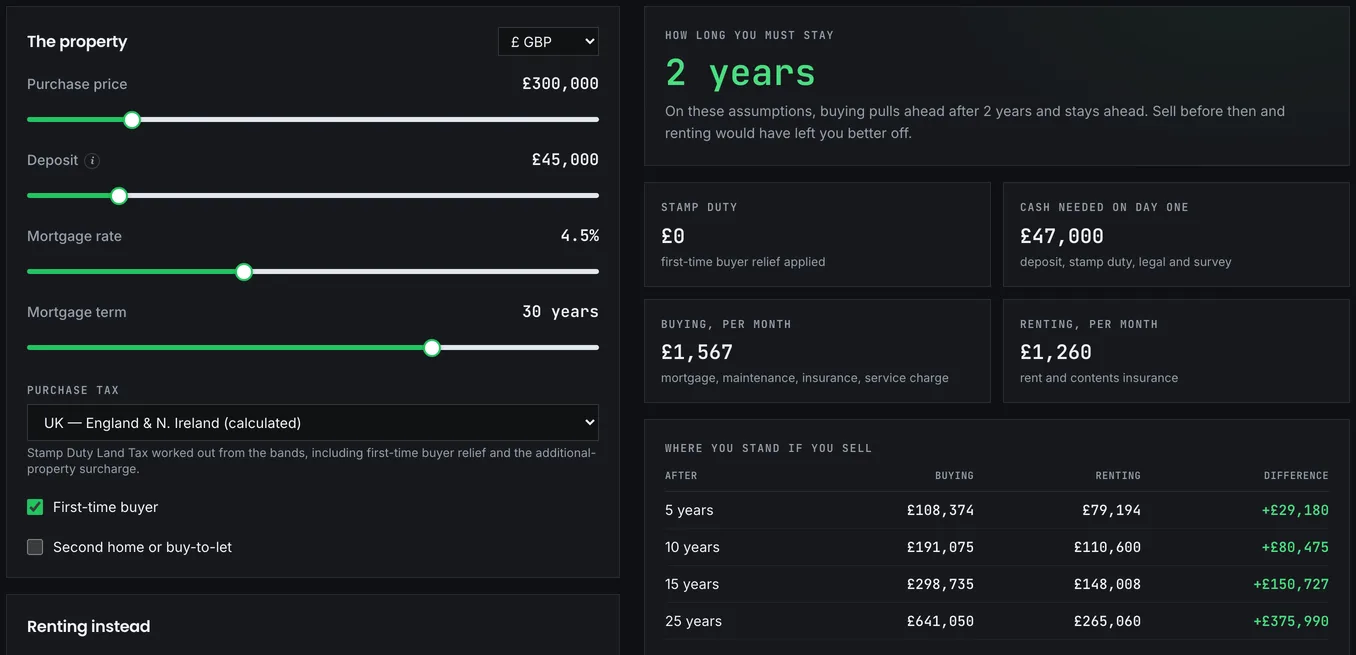
The calculator does not compare a mortgage payment against rent. It compares two people with identical monthly outflows. The buyer pays the mortgage, maintenance, insurance and service charge. The renter pays rent, and invests the difference, including the deposit they never handed over.
That last clause is what makes the comparison honest. A renter with £45,000 not tied up in a deposit is not simply £45,000 poorer than a buyer; they have £45,000 invested. Any comparison that ignores this is arguing for buying by rigging the question.
Building the purchase side
Purchase price and deposit set the loan, and the deposit also drives the day-one cash figure, which is usually larger than people expect. The mortgage rate should be what you would actually be offered, not the headline best buy: your loan-to-value determines the tier you land in, and a 15% deposit and a 40% deposit are different products at different prices. Remember too that fixed rates end. A five-year fix at 4.5% renewing into a different environment changes the arithmetic, and since the deals on offer then will reflect where the Bank of England's Bank Rate has moved in the meantime, no projection here knows what that environment will be.
The mortgage term changes the monthly payment substantially and the break-even year only modestly, because a longer term lowers the outflow and slows equity building, and the two effects partly cancel.
Purchase tax is where a global tool has to be careful. Set to UK: England & N. Ireland, it works Stamp Duty Land Tax out from the bands, applies first-time buyer relief, and adds the additional-property surcharge if you tick second home. The bands and reliefs themselves are published on GOV.UK's SDLT rates page if you want to check the calculator's working against the source. Scotland and Wales use different systems, and every other country has its own.
If you're outside England and Northern Ireland, switch the mode to a percentage and enter your own rate. Look up the actual figure for your country: transfer taxes range from near zero to well over 10%, and on a £300,000 purchase each percentage point is £3,000 of real money. The calculator won't guess it for you, because a wrong guess presented confidently is worse than an input box.
The first-time buyer box matters more than it looks in England. Relief cuts off at a purchase price cliff, and going a pound over it costs several thousand pounds instantly.
Being fair to the renter
Monthly rent should be for the equivalent property, not your current one. Comparing a two-bed flat you would buy against the room you rent now measures your housing upgrade, not the rent-versus-buy decision.
Rent growth compounds hard over a long horizon, and it's the assumption that most favours buying. Historically rents track wages more closely than house prices. Set it well above general inflation and you'll get a very short break-even, but the result will be a consequence of that assumption rather than a finding.
Investment return is what the renter earns on their invested difference. Use a real, after-fee figure and use the same basis as the house price growth you set, or the comparison quietly tilts.
What the break-even year is really saying
How long you must stay is the headline. Below that year, renting leaves you better off; above it, buying does. It answers the question people actually have, which is not "should I buy" but "should I buy given how long I expect to be here". And that phrasing carries a warning inside it, because whether you stay is exactly what no calculator can know. Job changes, relationships and children break plans, and a five-year break-even is not comforting if there's a realistic chance you relocate in three.
Cash needed on day one is deposit plus purchase tax plus legal and survey costs. This figure sinks more purchases than the monthly payment does.
The buying and renting monthly figures sit side by side beneath it. Buying is usually higher, and the gap is not waste; part is interest, which is genuinely gone, and part is capital repayment, which is yours.
Where you stand if you sell is the table underneath, showing both positions at 5, 10, 15 and 25 years, net of selling costs. Read across it rather than fixating on the break-even year: if buying is £2,000 ahead at year six, that's not a meaningful win, it's a rounding error against transaction costs. Transaction costs are why the break-even year exists at all. Buying and selling a house costs tens of thousands in tax, fees and agents, and you need enough time for growth and equity to outrun that.
A few things sit outside the model no matter how carefully you set it. Maintenance is applied as a steady annual percentage, while real maintenance is nothing for four years and then a £9,000 roof. And nothing non-financial appears anywhere: security of tenure, whether you can paint the walls, whether your landlord might sell next spring. These decide many real cases and none of them show up in the output.
Run it once honestly, then once pessimistically
Run your genuine numbers first. Then set house price growth to zero and see what happens. If buying still wins over your realistic time horizon, the case holds. If it only wins on optimistic growth, the case is a bet on the housing market rather than a housing decision.
Then check the monthly figure is actually affordable alongside everything else. The 50/30/20 budget planner will show whether the buying outflow leaves your needs share somewhere sustainable, and the emergency fund calculator matters more once you own; a boiler is your problem now.
If you already own and the question is whether to overpay, that's a different calculation entirely: the mortgage overpayment calculator handles it.
Currency, price and tax mode are all adjustable, so this works outside the UK, provided you supply the local transfer tax rate rather than leaving it on the UK bands.