
Car insurance is not an emergency. Neither is Christmas, the MOT, the annual dental check or the boiler service. Every one of them arrives on a schedule you could have written down years ago, and every year they land on a credit card anyway, because the date was predictable but no money was waiting for it.
Sinking funds fix that. You convert a known future cost into a monthly amount, save it in advance, and the bill stops being an event.
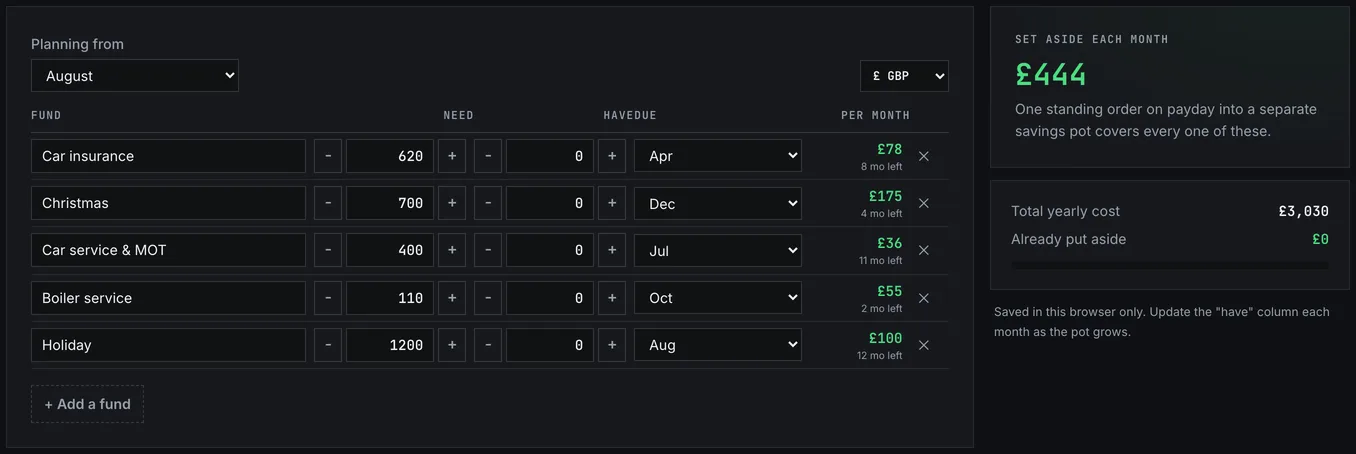
Dividing the bill by the months
For each expense you record what it will cost and when it is due. The tool divides the cost by the months remaining and hands you a monthly figure. Save that amount every month and the money is sitting there when the bill arrives; the expense has quietly become a line in your ordinary spending. The name comes from accounting, where a sinking fund sets money aside progressively against a known future obligation, and the domestic version is exactly the same idea at kitchen-table scale.
There are two ways to arrive at the monthly figure, and they suit different bills. For a genuine one-off with a deadline, divide by the months you have left: £600 due in eight months is £75 a month, and that is the whole calculation. A holiday works this way. For anything that recurs, divide by twelve instead and simply never stop. £600 of car insurance is £50 every month, permanently, resetting each time the bill is paid. This second version is the one that kills the problem for good, because by the time the next renewal turns up you have already been saving towards it for a full year.
If starting everything at once produces a monthly total you cannot meet, begin with the two or three largest pots and add the rest as debts clear or income rises. Partial coverage beats none by a wide margin: meeting half of a £600 bill from savings is a far smaller problem than meeting all of it on credit.
The washing machine you already know about
So what deserves a pot? Anything predictable, periodic and large enough to hurt when it arrives unplanned. The usual suspects: car insurance, road tax, MOT and servicing, home and contents insurance, Christmas and birthdays, holidays, annual subscriptions and professional memberships, dental and optical costs, pet vaccinations and insurance, school uniforms and trips.
Then there is a slower category, and it is the one most people miss entirely. Replacements. A boiler lasts perhaps twelve to fifteen years. A laptop four or five. A washing machine around ten, and a car will eventually need replacing, or need a repair that costs more than a month's pay. None of these is a surprise in any meaningful sense. You just don't know which year.
For those, work backwards from a rough replacement cost and a rough lifespan. £900 for a washing machine spread over ten years is £7.50 a month, a trivial sum to set aside, and the difference between a working machine and a finance agreement at 29.9%.
There is a simple test hiding in all of this: if you can name the expense, it is not an emergency. Emergencies are the ones you cannot name, and they need a different pot entirely.
Why Christmas must not raid the emergency fund
The two pots are frequently confused, and they do opposite jobs. A sinking fund covers a specific, expected cost with a known rough date. It is designed to be spent, and spending it is the plan working. An emergency fund covers what you could not see coming: job loss, an urgent repair, an unplanned trip. It should sit untouched, because spending it means something went wrong. The emergency fund calculator sizes that one properly.
Keeping them separate is what stops each from failing. Pay for Christmas out of the emergency fund and the emergency fund enters January permanently depleted, at exactly the point in the year when unexpected costs are most likely. Fund an actual emergency out of the Christmas money and December goes on a card. Each pot only works because the other exists.
Five pots and £178 a month
If the full list feels overwhelming, five pots cover most of what actually catches out a household running one car. Typical figures: car insurance at £620 a year wants £52 a month. MOT, servicing and tyres, around £400, take another £33. Christmas and birthdays at £500 across the year come to £42 a month, home and contents insurance at £250 is £21, and a rolling fund for appliance and tech replacement at £360 a year adds £30.
That comes to £178 a month, and it removes £2,130 a year of expenses from the category of things that arrive as a shock.
Your own figures will differ, sometimes considerably (the ONS's family spending survey shows just how widely household budgets vary), and the exercise matters more than the numbers. Total what these things actually cost you last year, divide by twelve, and you have your starting set.
Where the money waits
Instant-access savings, split into named pots if your bank offers them, at a provider whose deposits you have checked are FSCS-protected if you are using one of the newer app-based banks. Most UK banks now provide these free, and the naming matters more than it sounds: "Car insurance, due March" is considerably harder to raid on a Saturday than "Savings".
Not invested, though. These are known costs with dates attached, most inside a year or two, and market risk has no business anywhere near a bill you have to pay in March. And not in your current account either, where the money becomes indistinguishable from what you have available to spend.
The mechanics work best folded into your payday routine rather than run as a separate exercise. Allocate the pots alongside your fixed commitments, because functionally that is what they are, using the payday allocator, and move the money by standing order the day after you are paid. Once it is running, the effect on how a year feels is out of all proportion to the effort. The months that used to contain a nasty surprise contain a transfer from a pot instead, and the credit card stops being the thing that absorbs every predictable cost.
One last shortcut. If you have been logging with the Expense Diary, last year's entries are the best possible source for this list. Read back through the months you have recorded, and every large irregular expense you find is a candidate for a pot. Twelve months of real history beats any amount of guessing about what the year ahead plans to charge you for.