
On the 25th, the money in your current account is your salary. By the 8th it is simply "what is in the account", and the £200 you meant to save has become indistinguishable from the £200 you meant to spend. Money in a current account has no memory.
Budgeting tries to fix this by tracking what you spent. Allocating asks something easier and considerably more effective: decide where the money goes the day it arrives, before anything has a chance to happen to it. The payday allocator turns one month's pay into a set of amounts with destinations, while the balance still reflects the plan rather than the month. Anything you intend to save leaves before it can be reasoned with, and that timing is the mechanism behind almost every system that works: pay yourself first, zero-based budgeting, the envelope method. They differ in presentation and agree entirely on when the money should move.
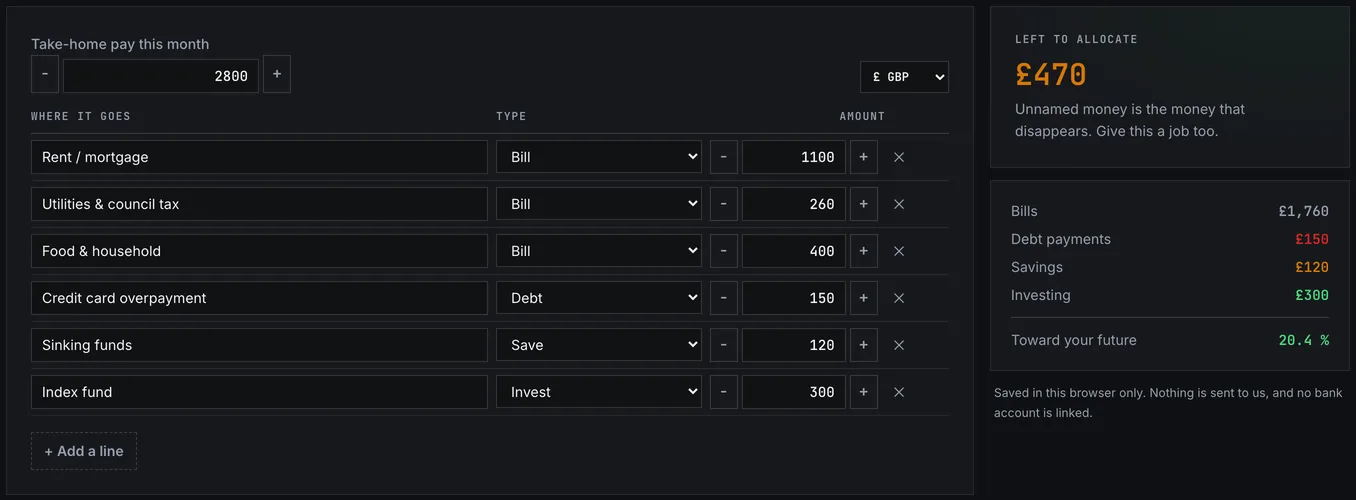
The order money should leave
Start with take-home pay, the actual figure that lands. If you are paid irregularly, run the allocator each time you get paid rather than trying to build a monthly average; there is more on variable income below.
Fixed commitments come out first. Rent or mortgage, council tax, utilities, insurance, minimum debt payments, travel. These are not decisions this month, they are obligations, and they leave before anything discretionary is considered.
Next, anything with a deadline. Money for a bill that arrives quarterly or annually belongs here, set aside monthly rather than met in a panic when it lands. This is what sinking funds are for, and folding them into the payday split is what stops car insurance being a crisis every single year.
Then savings and debt overpayments: emergency fund, investments, anything above the minimum on debt. Putting these before discretionary spending is the entire point of the exercise, because whatever comes last in the order gets whatever is left. Most people put saving last and then wonder why it never happens. The fix is not discipline. It is reordering.
Discretionary comes at the end, and what remains is genuinely yours to spend without tracking. People expect this part to feel restrictive and usually find it liberating, because money that has already cleared every obligation can be spent without any accompanying guilt.
£2,400 landing on the 25th
Watch it work on a real month. Take £2,400 of take-home pay. Commitments swallow £1,290 of it: rent £900, council tax £145, energy £95, water £32, broadband £32, phone £18, contents insurance £18 and £50 of travel. Sinking funds take another £145, split £52 for car insurance, £30 for MOT and servicing, £40 for Christmas and birthdays, and £23 towards replacements. Savings and debt get £400, as £150 to the emergency fund, £150 overpaying the credit card and £100 invested. That leaves £565 of discretionary money: £320 for groceries and £245 for everything else.
Two things stand out. The commitments run to 54% of take-home, slightly above the 50/30/20 guideline but not alarming. And the £245 of genuinely free money is a real figure that has already cleared every obligation, which feels very different from having £565 in the account and no idea which parts of it are spoken for.
Run yours, and the discretionary line is usually the surprise, in one direction or the other.
Two standing orders turn the plan into an outcome
The allocator produces a plan; two mechanical steps make it happen without you.
Set every savings and sinking-fund transfer to move automatically the day after your pay lands. The extra day protects against pay dates shifting around weekends and bank holidays, which is a tediously common way for a standing order to bounce. Then give the money somewhere to go: separate accounts, or at least separate pots. Money sitting in your current account is spending money regardless of the label you have given it in a spreadsheet. Most UK banks now offer pots or spaces at no cost, with the same FSCS protection as the main account, and the small friction of moving money back out is exactly the friction you want.
Do these two things and the plan runs itself. Nothing else in personal finance offers that ratio of effort to effect.
When the money runs out before the list does
Very often the fixed commitments plus the essentials come to more than the pay, and there is nothing left to allocate to anything else. That is information, not failure. It means the problem is structural rather than behavioural, and no amount of careful splitting fixes it.
What does fix it: reducing the commitments, where housing and transport dominate for almost everyone and are the only lines large enough to change the answer, everything else being rounding. Clearing the expensive debt, since minimum payments on high-interest balances consume the allocation every month and never shrink; the debt payoff calculator works out the fastest route out and what each cleared debt frees up. Or increasing the income, which is unfashionable advice because it is slow, and the only one of the three with no ceiling.
If you are unsure whether your commitments are genuinely too high or just feel that way, the 50/30/20 budget planner gives you a reference point. Needs running well above half your take-home is a housing problem, not a spending one.
Paid irregularly
Freelance, commission and shift workers can still allocate, with one adjustment: allocate against the amount that actually arrived, never against a hoped-for average. Set your fixed commitments and essentials from a poor month, so they are always covered, and in a good month send everything above that floor to savings and to a buffer account that smooths the lean ones.
And if you are self-employed, keep tax entirely separate. It is not income. It is money that has not been collected yet, and treating it as available is the single most common way a good year becomes a bad January.
The allocator sets intentions; the Expense Diary tells you what actually happened. Comparing the two after a couple of months is where the real learning is, because most people find one category they consistently under-allocate, and adjusting for it is worth more than any amount of resolve.