
Nobody cancels what they can't see. Subscriptions are built on that: individually small, automatically renewed, and priced monthly so the annual figure never appears anywhere you might notice it.
The subscription audit makes the annual figure appear. That's the entire trick, and for most people it's enough.
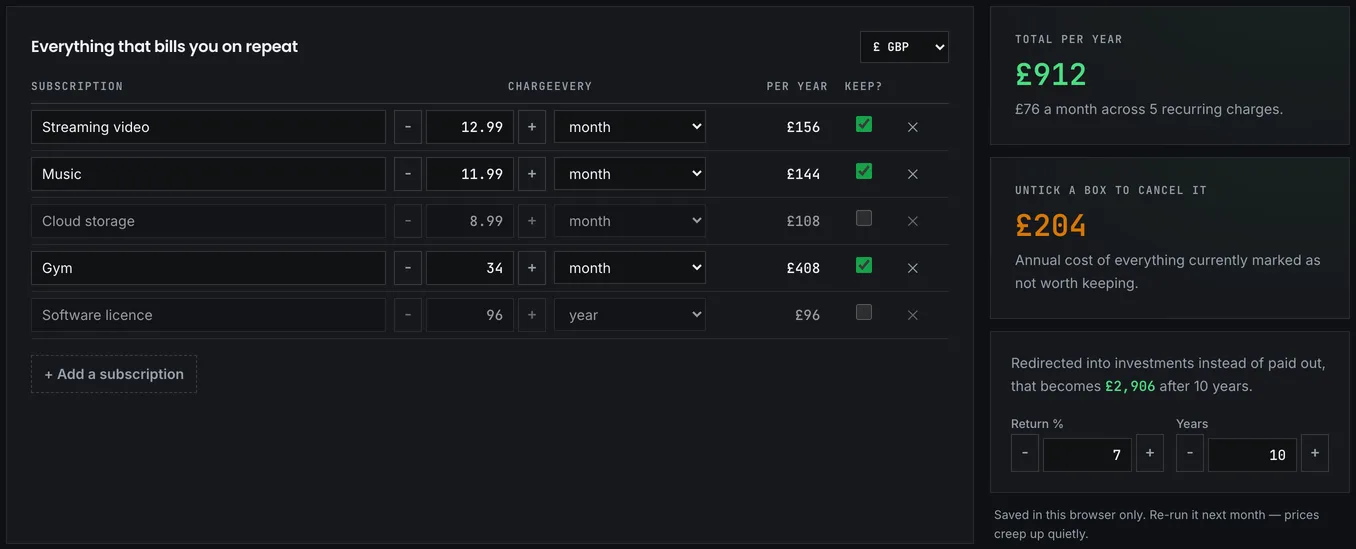
Three passes to find everything
The audit is only as good as the list, and almost nobody can produce a complete one from memory.
Start with bank and card statements, three months back. Three months rather than one, because quarterly and annual charges hide in the months you didn't check. Read every line rather than scanning; the ones you've forgotten are precisely the ones that won't jump out.
Then the app stores. Both Apple and Google keep subscriptions in a single settings screen, and they're frequently the ones people are most surprised by, since charges made through an app store don't always carry a recognisable merchant name on your statement. Finish with PayPal and any stored-card wallets, where recurring payments are easy to miss because they appear as one merchant regardless of what they're for.
If you've been logging entries in the Expense Diary, the Bills and subscriptions tab already holds anything you have recorded as recurring, and the annualised list there is a running head start on this exercise.
The number that does the work
Enter each subscription with its cost and cycle. The tool converts everything to a common basis and totals it.
That total is the point of the whole exercise. £11.99 a month is a decision nobody agonises over. £143.88 a year is a different proposition, and £143.88 a year for something watched twice since March is a different proposition again.
Weekly charges deserve particular attention, because the annualisation is the most brutal. A £3.50 weekly coffee subscription is £182 a year. A £6 weekly delivery pass is £312. The tool's cycles are monthly and annual, so enter a weekly charge by its yearly figure, fifty-two times the weekly price.
Then look at the combined figure. Totals between £600 and £1,500 a year are entirely ordinary for a household that has never audited, and the reaction to seeing it is usually the most productive thing the tool produces. None of this is an argument against subscriptions, to be clear. It's an argument against paying for them without knowing what they cost.
Keep, cancel, downgrade
Sort every line into one of three groups, and be quick about it; deliberating is how everything survives.
Keep is for things you use and value at a fair annual price. Most of the list should end up here, and that's a perfectly good outcome. Cancel now is for the unused, the forgotten, the duplicated, and anything kept for one thing you could get elsewhere. Duplicates are worth hunting specifically: cloud storage across three providers, two music services, overlapping streaming.
Downgrade is the group people skip, and it shouldn't be. An ad-supported tier, an annual plan instead of monthly, a family plan split with people you actually live with, or the smaller storage tier. This captures most of the saving without giving anything up, which makes it the group most likely to stick.
Two practical points. Cancel the moment you decide, because an intention to cancel later is worth nothing and the renewal will beat you. And check whether cancelling forfeits time you've paid for; many services run to the end of the period, so there's no reason to delay.
While you're deciding, a few recurring traps are worth naming. Free trials with a card attached want a calendar reminder set for two days before they end, at the moment you sign up; that's the single highest-yield habit here. Annual renewals arrive eleven months after any decision you made about them, by which point the charge is simply a thing that happens, so they deserve the most scrutiny precisely because they get the least. Price rises creep in through emails nobody reads, and the service you assessed as fair value at £7.99 may now be £13.99; the ONS's inflation figures give you a quick way to check how much of a rise like that general prices account for. And retention offers cut both ways: many services will offer a substantial discount when you try to cancel, which is worth attempting for anything in the downgrade group and worth ignoring for anything in the cancel group. A discount on something you don't use is still money going out.
The machinery you're up against
Understanding the design helps you resist it, and none of it is accidental.
Monthly pricing exists because the same service at £143.88 a year converts far worse than at £11.99 a month, and every provider knows it. The monthly frame is chosen precisely because the annual figure is the one that prompts a decision. Automatic renewal is the default because continuing then requires no action, which means the decision is only ever made by people who go looking for it. Cancellation carries friction by design: signing up takes thirty seconds on a well-built page, while cancelling is often several screens deep, occasionally by phone, and frequently interrupted by offers. And each individual amount is kept small enough that no single charge is worth the effort of reviewing. Only the total is, and the total is the one number never presented to you.
None of this makes subscriptions a scam. It does mean the only defence is a deliberate annual review, because nothing in the system will ever prompt one.
Move the saving before it evaporates
This matters more than the cancelling, because money that is merely no longer spent tends to get spent on something else within about two months.
Move it deliberately. Set up a standing order for the freed amount the day you cancel, pointed at whatever you're actually working toward: an emergency fund in an FSCS-protected account, a debt overpayment, a specific goal. The payday allocator is a good place to decide where it should go.
A £70 a month saving redirected rather than absorbed is £840 a year, and invested consistently over a couple of decades it becomes a genuinely serious number. The compound interest calculator will show you exactly how serious.
Then make the whole thing repeat itself. Once a year is enough, and the calendar reminder is the entire system. January is the obvious slot; the month after any annual renewal is a better one, since you'll catch it before it renews again rather than eleven months after.