
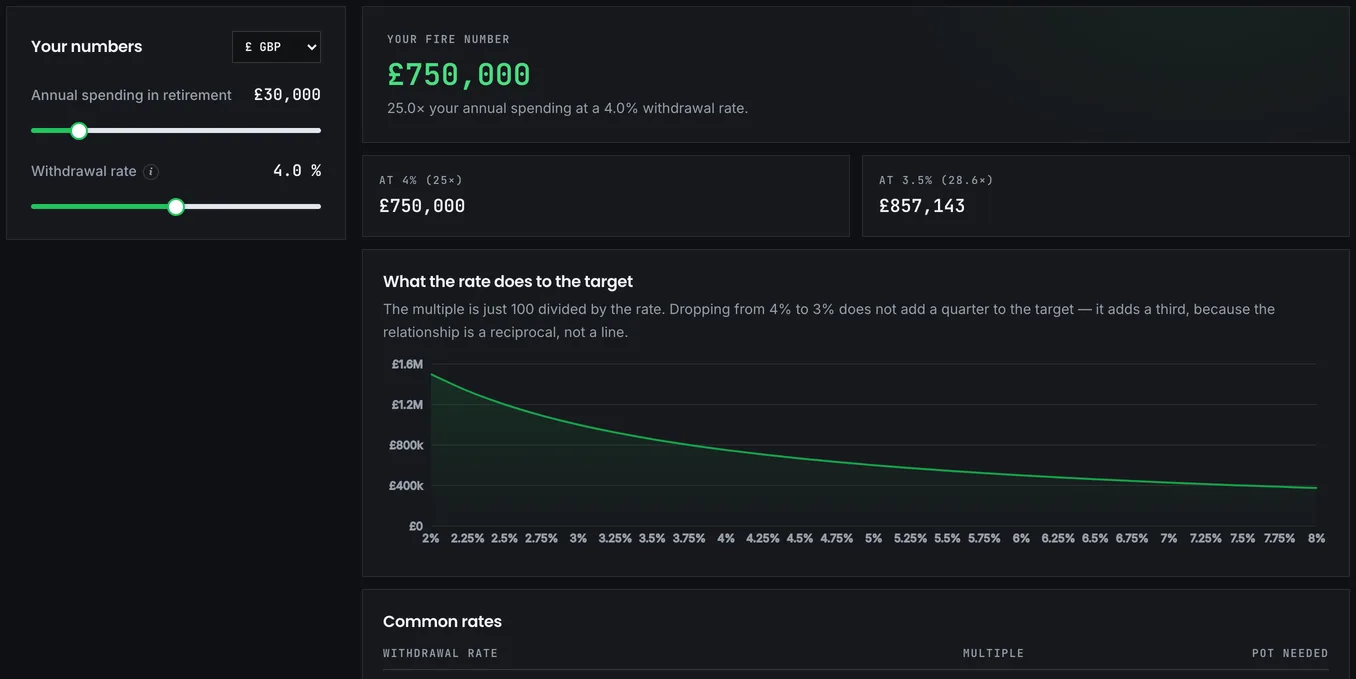
Multiply your annual spending by 25. That's your retirement target.
No other number in early retirement gets quoted as often, and the 25x rule tool applies it in seconds, though its real value is that you don't need a tool at all. You can do the sum in your head, in a lift, halfway through a conversation. What you do need is a feel for when the shortcut holds and when it quietly misleads you, and that's what the rest of this guide is about.
One divided by 0.04
That's the whole derivation. Twenty-five is the reciprocal of 4%. Nothing deeper is going on.
The two ideas are a single statement read from opposite ends. A 4% withdrawal rate says "take 4% of the pot each year". The 25x rule says "build a pot 25 times what you spend". Neither adds anything the other lacks, which means every caveat attached to the 4% figure applies here in full, and there are several; the safe withdrawal rate guide covers them properly. The research behind the figure, published by the Trinity authors themselves in the Journal of Financial Planning, examined US market history over a 30-year horizon. Both of those conditions matter more than most people quoting the rule seem to realise.
Retire at 45 and the 30-year horizon no longer describes you. Longer retirements need a lower withdrawal rate, which means a higher multiple; 28 to 33 is the range most early-retirement analysis points to, and 33 is simply the reciprocal of 3%. Invest outside the US and the history changes underneath you as well, since UK data has generally supported a lower sustainable rate, which again pushes the multiple up. And the original research assumed a growth-oriented portfolio paying no charges at all. Hold a lot of cash or bonds and a cautious portfolio can't sustain the same withdrawal. Pay meaningful fees and they come straight out of the margin the rule relies on; the fee impact calculator shows how much margin that actually is.
One factor pushes the other way. Expecting other income (a state pension arriving at 67, a defined-benefit scheme, rental income) reduces what the portfolio must produce, so you should apply the multiple only to the gap, not to your total spending. For someone stopping at 60 with a state pension due, applying 25x to the whole figure overstates the target substantially, and overstating a target by hundreds of thousands of pounds is not a harmless kind of caution. It has a price in years.
The £60,000 subscription
Used as intended, the multiple is a fast sanity check, and it's genuinely good at that.
Someone mentions they'd like to retire early on £40,000 a year. Twenty-five times that is £1m. Now the conversation has a real number in it, and it took two seconds.
It also reframes spending in a way ordinary budgeting doesn't. A £200-a-month subscription habit is £2,400 a year, which is £60,000 of pot you have to build before you can retire with it intact. Costs stop being monthly annoyances and become capital requirements, and that changes how they feel. The translation runs in both directions too: every permanent £100 a month you remove from your spending takes £30,000 off your target, which is the rare kind of maths that makes cancelling something feel like a pay rise.
So treat the multiple as a conversation-starter, not a plan. It's precise enough to be useful and simple enough to be dangerous if you stop there.
£32,000 a year, three different targets
Take £32,000 of annual spending and watch what the choice of rate does to it. At 4% the multiple is 25 and the target is £800,000. At 3.5% the multiple becomes 28.6 and the target £914,000. At 3% it's 33.3, and the pot has climbed to £1,067,000.
The spread between the first answer and the last is £267,000. For the identical lifestyle. At a 40% savings rate that's roughly five extra years of work, decided entirely by which percentage you picked before you started.
Which is why treating 25 as a fact rather than a choice is expensive in both directions. Pick it when a longer horizon called for 33 and you retire on a plan with much less margin than you believed you had. Pick 33 when 25 would have done and you work five years you didn't need to. The multiple was never the hard part. Deciding which one applies to your situation is, and that decision deserves more thought than inheriting the number everyone quotes.
A pot of the right size in the wrong wrapper
Even with the right multiple chosen, the answer hides things.
Tax, first. The multiple works on gross withdrawals, and whether your money sits in a pension or an ISA changes what you actually receive, sometimes considerably. Then access, which is the one that catches UK savers in particular: a pot of the right size in the wrong wrapper doesn't let you retire, because UK pensions are locked until 55, rising to 57 from 2028. The pension bridge calculator handles that gap, and the 25x rule is completely silent on it.
Sequence risk hides in there too. The multiple is a single number, and a single number cannot express the fact that when your returns arrive matters as much as their average. Retire into a crash and an "adequate" pot can fail; retire into a boom and a thin one can coast. Only a simulation shows that, and the Monte Carlo simulator is where to run it.
But the real weakness is your spending estimate. The multiple amplifies whatever you feed it by 25, so an estimate that's £4,000 a year too low produces a target £100,000 too small. The arithmetic is trivial and the input is the hard part, which is exactly backwards from how most people spend their time on this.
Ten seconds now, the real work later
Use 25x to get a number in ten seconds. Then, if the number matters, do it properly.
Ground the spending figure in a few months of the Expense Diary rather than an estimate made in your head. Pick a withdrawal rate that suits your actual horizon rather than the default. Then build the projection in the FIRE calculator, which turns the target into an age and accounts for what you already hold and what you add each month. The shortcut and the plan aren't competing; the shortcut tells you whether the plan is worth building at all.
The rule has earned its popularity. It compresses a genuinely complicated question into arithmetic you can do while walking, and it turns abstract spending decisions into concrete capital requirements. Just remember that its simplicity is a summary of the research rather than a substitute for it, and that the one input it depends on entirely is the one most people have never actually measured. Measure that one properly and the rest of the arithmetic looks after itself.