
It is year seven of your retirement. The portfolio is down 28%, the transfer that funds your life is due, and you have to decide whether to take the same amount anyway.
Your withdrawal rate never answered that question. Choosing the rate settles how much you take in year one and nothing more, yet the rule you follow every year afterwards matters more to whether the money lasts than the starting percentage does. The withdrawal strategies tool compares the main approaches.
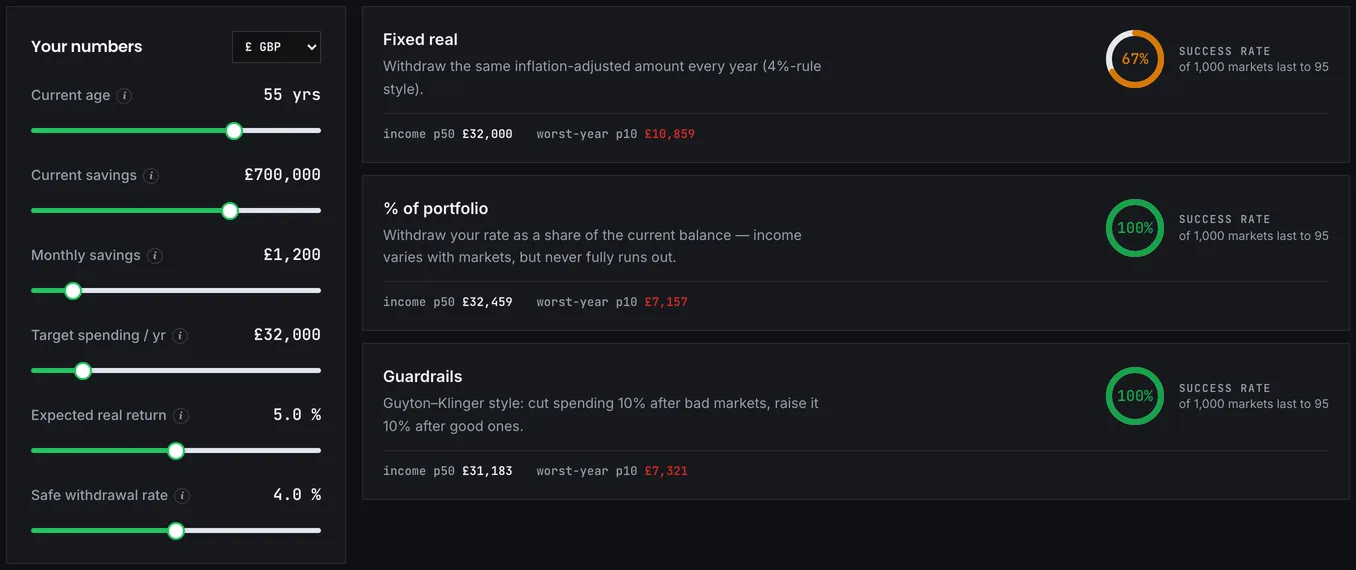
Fixed real
Take a set amount in year one, then increase it by inflation every year regardless of what the portfolio does.
This is the rule behind the 4% research (the Trinity authors' own paper tests precisely this inflation-adjusted withdrawal) and behind most retirement planning. Its virtue is a completely predictable income: you know what you are getting in year twenty-two. Its flaw is that it is blind. In a severe fall you keep withdrawing the same real amount from a shrinking pot, which means selling an ever-larger proportion of what remains, and that mechanism sits behind nearly every failure in retirement modelling. It is why fixed real requires the most conservative starting rate. The rule suits anyone with little room to cut, where spending is mostly fixed costs, and anyone who values certainty of income above the size of it.
Percentage of portfolio
Take a fixed percentage of whatever the portfolio is worth each year.
This rule cannot fail arithmetically. A percentage of a positive number is always a positive number, so the money never runs out. What it does instead is move the risk onto your income: a 30% market fall means a 30% income cut, that year, immediately. Take 4% of a £700,000 pot and you get £28,000; let the pot fall to £490,000 and you get £19,600. An £8,400 drop with no notice. It suits someone with substantial discretionary spending, or other income covering the essentials, so that a bad year means a cancelled holiday rather than an unpaid mortgage.
Guardrails
The middle path, and for most people the best of the three.
Take a starting percentage as normal, then set boundaries. If the portfolio falls far enough that your withdrawal has become a much higher percentage of it than planned, cut spending by a set amount. If it rises far enough that the withdrawal has become a much smaller percentage, give yourself a raise. Between the guardrails nothing changes, so you keep the predictability of fixed real; only at the extremes does the rule intervene, and it intervenes early enough to matter.
This is what actual retirees do informally anyway. Guardrails simply make it explicit and decided in advance, which is the point. The cut you agree to in year zero is the one you will actually make; the cut you leave to your future self, mid-crash, competes with the hope that markets recover next quarter. Choosing to cut spending is far easier as a rule agreed in year zero than as a judgement call in the middle of a crash, and that is why guardrails suit almost everybody and earn their extra complexity.
One bad decade, three incomes
Take £700,000 and a 4% start: £28,000 in year one. Now suppose the portfolio falls 30% during year two and takes six years to recover.
Fixed real pays £28,000, then £28,700 the next year as inflation is added, then more again, from a pot that has dropped to around £460,000 after the fall and the withdrawal. The withdrawal is now over 6% of what remains. Every year of the recovery is spent selling a larger share of a smaller portfolio, and the pot that emerges at the far end is permanently smaller than it should have been.
Percentage of portfolio pays roughly £18,400 in the bad year, a cut of nearly £10,000 arriving without warning. Brutal to live through, and the portfolio is left almost intact to recover.
Guardrails pays something in between, perhaps £25,000: a cut of around 10%, held until the portfolio recovers past the lower boundary, then restored. The third produces an income you could plan around and a portfolio that survives. That is the whole case for it.
Reading the comparison honestly
The tool shows income year by year under each rule, using the same portfolio and the same market path. Watch the worst year, not the average, because every strategy looks similar in a good sequence; the whole difference between them appears in a bad one, and the worst year is where you find out what you are actually signing up for. Watch how long a cut lasts, too. A 15% reduction for two years is an inconvenience, while the same reduction sustained for eleven years is a different retirement, and percentage-of-portfolio can produce exactly that after a prolonged fall. Then watch the ending balance: flexible rules typically finish with more money, because they took less during the periods that would have done the most damage, and if leaving something behind matters to you, that is a real consideration.
Keep in mind what the model leaves out while you read. These are gross withdrawals, and tax changes them: taking £30,000 from a pension and from an ISA are not the same after tax, and the order you draw accounts in changes the answer. Income arriving later changes them too; a state pension starting at 67 (your own date is on the government's State Pension age checker) transforms the arithmetic of the years after it and reduces what the portfolio must carry. And real retirement spending is not flat. It is typically higher in the active early years, lower in the middle, and can rise sharply at the end with care costs.
Choosing your rule
Ask one question: how much of your spending could you actually cut, and for how long?
If the honest answer is very little (the mortgage is not paid off, care costs are fixed, there is no slack), then fixed real is the appropriate rule and your starting rate must be conservative to compensate. Set it using the safe withdrawal rate tool and err low. If a meaningful slice of your spending is genuinely discretionary, guardrails let you start higher than fixed real would allow, because the rule protects the portfolio when it needs protecting. In practice that often means retiring a year or two earlier for the same level of safety.
Whichever you pick, remember that every rule assumes you follow it, and the most common actual failure is abandoning the plan in a downturn and selling everything. So test your rule before you lean on it. The Monte Carlo simulator shows how often it survives across many random sequences, and the retirement backtest shows how it would have handled the real ones. The difference a flexible rule makes to both is usually larger than any other single change available to you.