
A £12,000 part-time job can take £300,000 off the pot you need. That sounds like a conjuring trick, but it's just arithmetic, and it is the entire case for Barista FIRE.
The idea sits between working and stopping. You leave the career job, take something part-time or lower-paid that covers part of your spending, and let the portfolio cover the rest. The name comes from the American habit of taking a coffee-shop job for its health insurance; in the UK the insurance angle does not apply, but the arithmetic does, and it is more forgiving than most people expect. The Barista FIRE calculator models it.
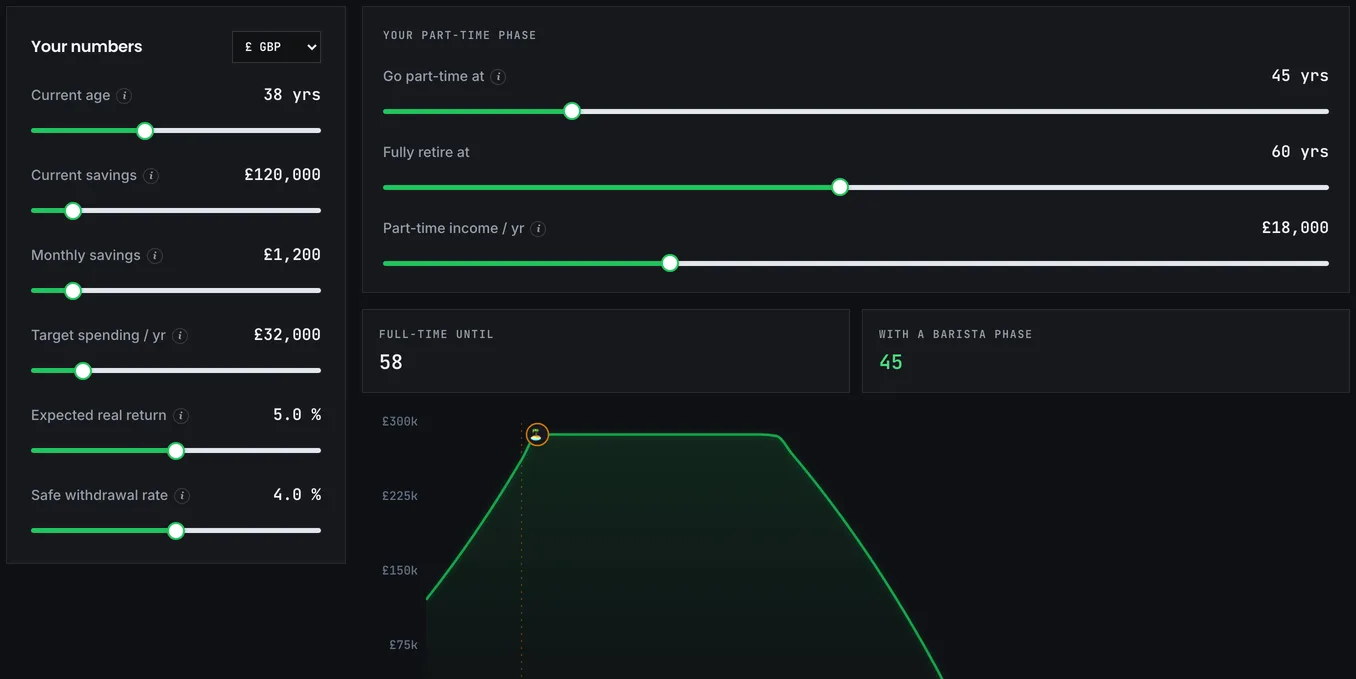
Where the £300,000 goes
The portfolio only has to cover the gap between your spending and what you earn, and because the target pot is a multiple of that gap, shrinking the gap has a leveraged effect. Spend £30,000 with no income and you need £750,000 at a 4% rate. Earn £12,000 part-time and the gap falls to £18,000, so you need £450,000. The modest job has removed £300,000 from the target: twenty-five times the earnings, because that is exactly what the multiple does to every pound you don't have to withdraw.
Very few financial decisions move a target by that much. Almost none of them are available to someone who has already decided how much they can save.
Setting up the phase
The calculator's inputs follow the shape of the plan itself.
The barista phase start and end ages define the working stretch. Most people run it from leaving the career job until their pensions or the state pension become accessible, which is the natural endpoint: once guaranteed income arrives, the case for even part-time work weakens.
Annual income during the phase should be net, and realistic. Part-time work pays less per hour than you may assume, and the roles that are genuinely low-stress tend to be the ones that pay least. That's fine. The point is to work less, not to earn well, and a plan built on an optimistic wage is a plan that quietly fails in year three.
Spending stays as it is elsewhere on this site: what you need each year, in today's money. Everything after the phase reverts to a normal projection, with the portfolio carrying the whole load.
The output is a comparison: the age full-time work would otherwise run to, next to the barista start age you chose, with the projection chart showing whether the money holds through the phase and beyond. The pot that makes the phase safe is the arithmetic from the top of this guide, twenty-five times the gap, and reaching it is the point at which you can hand in your notice.
Two years instead of ten
Someone is 42, spends £30,000, has £340,000 invested and can save £1,400 a month. Full FIRE needs £750,000, and at 5% real they reach it at around 52. Ten more years of the career job.
Barista FIRE at £14,000 a year part-time leaves a £16,000 gap, needing £400,000. They already have £340,000, so they reach it in two years, at 44.
Eight years earlier, for the price of working part-time rather than not at all. And the honest framing matters here: this is not retirement. It is quitting the job you want to leave, years earlier than full FIRE would allow. For many people that turns out to be the actual goal once they examine it. The thing they want is not endless free time; it is an end to the specific pressure of their current role, and a three-day week at half the pay, starting eight years sooner, delivers most of that.
There's a quieter advantage stacked on top, and it is worth stating precisely, because the obvious version of it is wrong. The starting withdrawal rate is no lower than full FIRE's: a pot built to twenty-five times the gap is drawn at the same 4% from day one. What the earnings buy is flexibility in exactly the years when sequence risk does the most damage. If markets fall early, a part-timer can add hours or postpone the next step, levers a full retiree does not have, and at 5% real the pot keeps growing straight through the phase even while being drawn on: our 44-year-old's £400,000 is around £478,000 by 57 despite funding the gap the whole way. The crash test shows what those early years do to a plan with no such levers. Arriving eight years earlier while keeping an escape hatch open is why the barista version deserves a serious look from anyone who assumed the choice was binary.
What Britain changes
The NHS removes the original American motivation entirely, which makes the UK version purely a financial calculation. But three British details still shape it.
National Insurance credits are the one people miss. You need 35 qualifying years of National Insurance for a full new state pension, low earnings may not generate a qualifying year, and a long barista phase could leave gaps. Check your NI record before committing; voluntary Class 3 contributions can fill gaps if needed, often at very good value.
Pension contributions usually carry on without you thinking about it. Part-time employment normally means auto-enrolment and an employer match, which keeps building a pension you cannot touch yet but will need later. And the personal allowance works unusually hard here: a part-time income below it is effectively tax-free, and combining it with drawdown from an ISA produces a tax position most full retirees cannot match.
The imagined café and the real one
The plan's weak point is rarely the maths. It's the job. A comfortable, low-stress, part-time role that fits around your life is easy to imagine and harder to find, particularly at 50 in a field you have left, so test the assumption before relying on it. Part-time work is also more exposed to hours being cut than a salaried role, and a plan that requires exactly £12,000 a year for eleven years has a thin margin. If the portfolio underperforms, the barista years extend; that is a soft failure rather than a hard one, which is part of the appeal, but it should be expected rather than arrive as a surprise. And leaving a career for lower-status work is a real identity shift. People who haven't thought about it in advance often find it harder than the money side.
Before you commit, place the idea against its neighbours. Coast FIRE is a genuinely different move: there you keep working normally but stop contributing, so coast is about contributions where barista is about hours. The FIRE calculator covers the full-stop version and supports a semi-retirement phase directly, so you can compare the two side by side. And whatever you plan, check the access question separately: if the barista phase ends before you can reach your pension, the years in between still need funding, and the pension bridge calculator works out whether your accessible savings cover them.