
Plenty of people who are not short of money still go overdrawn. Their monthly income comfortably exceeds their monthly outgoings, and yet on the 19th the balance dips below zero anyway.
That is not a budgeting problem, and no budget will fix it. It is a timing problem, and it needs a calendar. The cash flow calendar maps when money actually arrives and leaves across the month, day by day.
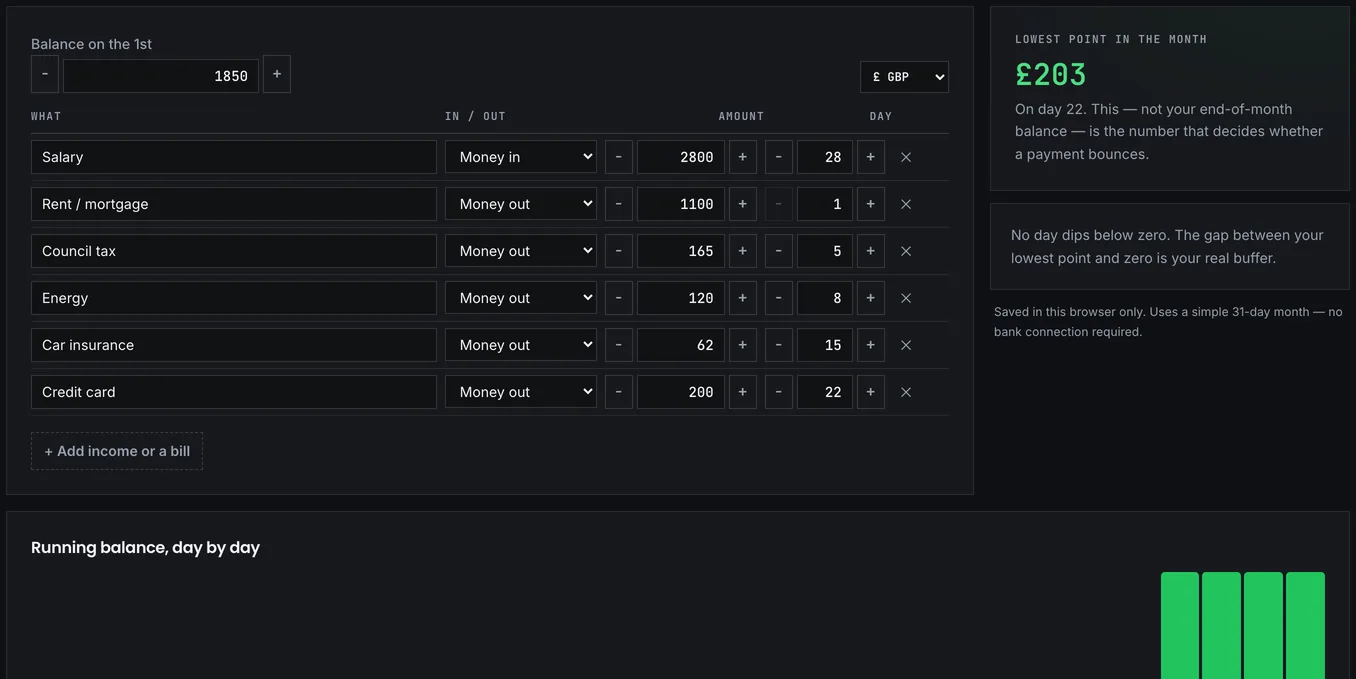
Why a monthly total hides it
A budget compares two figures for the whole month. £2,400 in, £2,150 out, £250 spare: nothing to see, carry on.
But money does not arrive as a lump and leave evenly. It arrives on one day and leaves in clusters: rent on the 1st, four direct debits between the 2nd and 6th, the credit card on the 12th, the phone on the 15th. So the monthly total is comfortably positive while the balance on the 14th is not. A month can be profitable and still go overdrawn, because income and outgoings are two numbers while cash flow is a sequence, and only the sequence tells you what happens on the 14th.
The calendar draws the running balance for every day of the month. It is the only view that surfaces this.
Real dates, not nominal ones
Setting it up means entering each income with the day it lands and each regular outgoing with the day it leaves. Simple enough, but two habits separate a useful calendar from a decorative one.
The first is using the dates money genuinely moves on. If your salary is paid on the last working day, that is the 28th in some months and the 31st in others. If a direct debit is nominally taken on the 3rd but the 3rd falls on a Sunday, it usually goes on the 4th. These small shifts are exactly what produces the near-misses, so a calendar built on the tidy nominal dates will miss the very thing you built it to catch.
The second is completeness. Everything that leaves automatically goes in, however small, because it is the accumulation of little direct debits in the first week that produces the dip, not any single one of them.
Day-to-day spending is different. Leave groceries and coffees out of the fixed entries and treat whatever remains after the fixed items as the amount available for them. That is the useful reading anyway.
The lowest point is the answer
Once the month is mapped, one number matters more than all the others: the lowest point the running balance reaches. That is how much headroom you genuinely have, and it is almost always lower than people expect.
When the low point occurs tells you what kind of fix you need. A dip on the 4th, straight after the bill cluster, is a different problem from a slow decline that bottoms out on the 25th. And whether it crosses zero is the immediate question: if it does, and an arranged overdraft absorbs it, you are paying a lender for the privilege of a timing mismatch rather than an actual shortage; the FCA's consumer pages are worth a look before treating an overdraft as a standing arrangement.
Timing problems have timing fixes
None of the fixes require earning more or spending less, which is what makes this whole exercise so satisfying.
The most effective one is also free: move the dates. Most lenders and providers will change a direct debit date on request, usually in a couple of minutes online, and shifting two or three of the largest away from the cluster and toward the days after payday can remove a dip entirely. If several bills land in the same three days, spreading them across the month smooths the whole shape.
Then put payday itself to work. Set savings and sinking-fund transfers for the day after pay arrives, so the money that should not be spent leaves before the bills do rather than competing with them; the payday allocator covers the order this should happen in.
The most durable fix, and the hardest one to start, is a small buffer. Keep one month's outgoings permanently in the current account and the cycle breaks for good: you are always spending last month's income, and the day of the month stops mattering entirely. The only obstacle is finding a month's float once.
A month that looks fine and is not
Someone takes home £2,400 on the 28th and has £2,150 of regular outgoings. Comfortably ahead on paper.
Their bills fall like this: rent £900 on the 1st, then £322 of direct debits between the 2nd and the 6th, the credit card minimum on the 12th, and the phone on the 15th.
By the 6th, £1,222 of a £2,400 balance has gone. Nine days. What remains has to cover groceries and everything else for three more weeks, and the running balance bottoms out somewhere around the 24th, days before pay arrives. The £250 monthly surplus is entirely real; it simply is not available for most of the month, and the last four days before payday are spent hoping nothing unexpected happens.
Moving two direct debits from the 3rd to the 29th, the day after pay lands, changes nothing about the totals and removes the dip completely. That is the kind of fix this view exists for.
Awkward pay rhythms
The calendar earns its keep most where pay refuses to behave. Anyone paid four-weekly rather than monthly has thirteen pay periods a year against twelve sets of monthly bills, so the alignment drifts through the year; the calendar makes that drift visible before it causes a problem rather than after. Households with two incomes on different dates, one paid on the 15th and the other on the last day, have a natural rhythm worth arranging bills around rather than fighting. And for the self-employed, whose invoices are paid at unpredictable intervals, mapping the outgoings alone reveals the minimum buffer worth holding, a far more useful number than any monthly average.
When it is not a timing problem
The calendar handles timing. It cannot handle amounts.
If the lowest point is negative because outgoings genuinely exceed income rather than merely arriving first, no rearrangement of dates will fix it, and if debt repayments are part of what makes the sums impossible, free advice from StepChange will do more than any calendar. The 50/30/20 budget planner will show whether commitments have simply grown too large a share of what comes in.
And once you are logging entries anyway, the Expense Diary does this continuously. Its safe-to-spend figure is your balance minus every bill due before your next payday: the same insight, applied to today rather than to the month ahead.