
Most retirement tools answer one question: how big does the pot need to be before you can live off it? The Coast FIRE calculator answers a narrower one, and for anyone with decades of runway it is often the more interesting of the two. How big does the pot need to be today for growth alone to carry it the rest of the way?
Past that size, you could stop contributing entirely and still retire on time. You still work, you still cover your living costs; the investments just no longer need feeding.
Why the answer is smaller than you expect
Because compounding does the remaining work, the coast number sits far below the full FIRE number, and the gap widens the younger you are. At 5% real, with the tool's target age of 67, a 28-year-old coasts on roughly a seventh of the eventual target, a 40-year-old on just over a quarter, and even a 55-year-old on little more than half. The shorter the runway, the closer the coast number creeps to the full one.
This is the clearest illustration going of why early contributions matter disproportionately. The money you invest at 25 is not doing slightly more work than the money you invest at 45. On the same assumptions it is doing close to three times as much.
The runway, the pot and the rate you must defend
Current age comes first, and it sets the runway on its own: the tool fixes the target age at 67, close to the state pension age most of today's savers face, so every year between now and then is a year of compounding. That fixed endpoint makes your age the input the answer is most sensitive to.
Current invested amount is the pot doing the coasting, and it means invested assets only. Not the house, not the emergency fund.
Annual retirement spending drives the target the same way it does in any FIRE sum, and it deserves a moment of honesty when you type it. The target is a multiple of this figure, so if your expected spending drifts upward after you stop contributing, the number you coasted to quietly stops being the right number.
Expected real return is after inflation, and over a thirty-year runway a percentage point either way moves the coast number substantially. Be conservative here, more conservative than feels natural, because coasting removes your ability to correct course later. A plan built on 7% real that delivers 4% will miss, and you may not notice until the correction is expensive. Fees eat from the same plate: a 1% charge against a 6% return removes a sixth of the compounding the whole plan rests on, which over thirty years is not a trim. The fee impact calculator shows the scale, and whatever your all-in charge turns out to be should already be subtracted from the return you enter.
Withdrawal rate converts spending into the target pot. 4% is the usual starting point, and the safe withdrawal rate tool covers why that number is more contested than it appears.
Thirty years of growth versus fifteen
Someone is 37, spends £30,000 a year and assumes 5% real growth with a 4% withdrawal rate. Their FIRE number is £750,000, twenty-five times spending. Their coast number is much smaller, because the thirty years left to 67 multiply a pot roughly 4.3 times at 5%, and £750,000 divided by 4.3 is about £174,000. Hold that at 37 and they never have to contribute another pound to retire at 67 on £30,000 a year.
Now move the same person to 52, with fifteen years left. Fifteen years at 5% multiplies a pot only about 2.1 times, so they would need roughly £361,000. More than double, for the same eventual outcome. Run it with your own figures, because the gap is always larger than people guess.
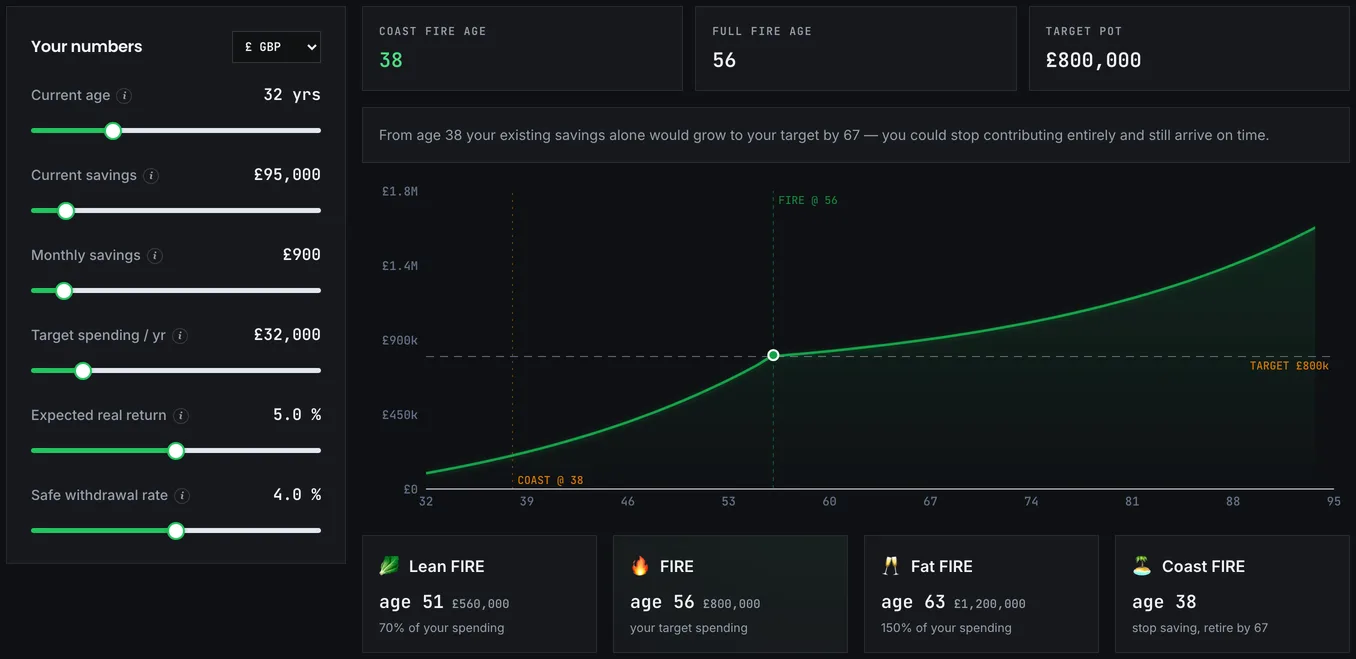
The results panel's headline is your Coast FIRE age: the year your current savings and contributions cross the coast threshold, the year you could stop feeding the pot if you wanted to. It sits beside the full FIRE age and the target pot, so both milestones stay in one view. The coast number itself, the pot required today, is the division above; run it against what you actually hold. And if you are already past it, that is worth pausing on: every further contribution now buys something other than retiring on schedule. Retiring earlier, retiring richer, or a wider margin for the return assumption being wrong.
One thing the calculator's smooth average cannot show you is sequence. Real markets do not deliver 5% every year, and a poor first decade after you stop contributing is much harder to absorb than a poor decade while you are still adding money, because nothing is buying at the low prices. The Monte Carlo simulator runs your figures across many market sequences instead of one average and tells you how often the coast actually holds.
Before you cancel the direct debit
Reaching the number is a change in options, not obligations. Most people who get there keep investing; knowing you could stop is the thing that alters how work feels. And coasting means covering your living costs from earnings while adding nothing to investments, which is a lower bar than your current salary but is not zero. In practice it enables a sabbatical, dropping to four days, moving to work that pays less and matters more, or starting something that will not pay for a while. It does not mean stopping work.
Two checks before you act on any of it. First, the employer match. If a chunk of your contributions comes from a workplace pension match, ceasing contributions usually forfeits it, and giving up a 100% return on those contributions is expensive. Continuing at the minimum that keeps the match is often worth it regardless of what the coast arithmetic says. Second, where the money actually sits. Coasting to a number held mostly inside a pension does not let you stop at 50, because anyone in their forties or younger today faces a minimum pension access age of 57; the pension bridge calculator works out whether your accessible savings cover the years before that door opens.
If what you actually want is part-time work rather than a full contributions stop, that is Barista FIRE, which models earning a smaller income during the gap. And the full FIRE calculator covers the whole projection, with Coast FIRE appearing inside it as one of the ages it reports. Treat this milestone as a marker within a plan rather than a plan in itself. Most people pass it, notice, and carry on, with a materially different relationship to their job.