
Plenty of couples arrive at this tool having each run a FIRE number years before they met. Adding those two numbers together feels sensible, and it's the exact mistake this calculator exists to fix. Two people planning together is not one plan with bigger figures: different ages mean different access dates, allowances double, spending does not, and one of you may not want to stop at all.
The couples FIRE calculator handles both sides properly instead of averaging them into a single fictional person.
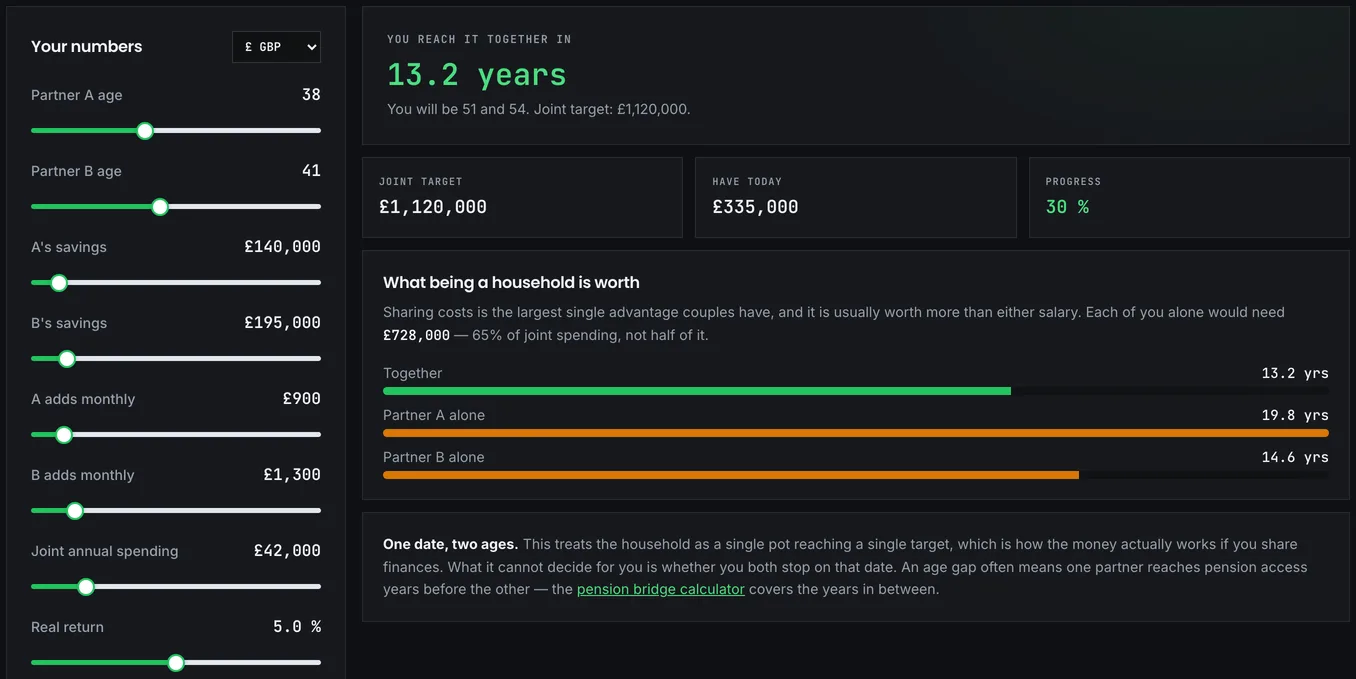
One household, not two budgets
The most important input is joint annual spending, and the key point is that two people do not spend twice what one does.
Housing is shared. Council tax is one bill with a single-person discount removed rather than doubled. Utilities, broadband and a car cover both. Food roughly doubles; most other things don't.
Research into household costs has long put a couple's requirement at somewhere around 1.5 times a single person's for an equivalent standard of living, not 2. Applied to a FIRE target, that difference is enormous: at a 4% rate it is the gap between needing 25 times a doubled figure and 25 times a shared one.
This is the single largest financial advantage of planning together, and it's why two people on modest incomes frequently reach FIRE faster than one person on a large one.
The allowances that come in pairs
Several UK allowances are per person, which is worth planning around deliberately rather than discovering by accident. The ISA allowance is £20,000 each, so £40,000 a year between you, and a couple filling both has substantial tax-free capacity along with a much easier time building a bridge pot. The personal allowance doubles up too: each of you can draw an amount of taxable income before paying anything, so splitting withdrawals across two people in retirement is considerably more efficient than drawing everything through one. A household needing £30,000 of taxable income pays far less tax taking £15,000 each than £30,000 from one pension. Marriage Allowance adds a smaller wrinkle: if one of you earns below the personal allowance, part of it can be transferred to a basic-rate-paying partner. And pension contributions work per person as well, where the lower earner contributing enough to capture their own employer match is usually better value than the higher earner adding more.
Holding assets in the right name is not a detail here. It's worth real money over a long retirement, and it is much easier to arrange while you're both still working.
The age gap in the plan
An age gap complicates the timeline in ways a single projection cannot show.
The older partner reaches pension access and state pension age sooner. That is genuinely useful: their pension can carry part of the household through the tail of the younger partner's bridge, reducing what needs to be accessible at the moment you both stop. The pension bridge calculator is worth running for the younger partner specifically.
It also means the plan has to fund the younger partner for longer. A five-year gap can mean the portfolio supporting one person for five years beyond the point it supports two, and longevity differences extend that further.
What sharing is actually worth
Two people each earning £38,000, each saving £900 a month, sharing a household that costs £36,000 a year.
Planned separately, each would need to cover roughly £24,000 of individual spending: a £600,000 target each, £1.2m between them. Planned together, the household target is 25 times £36,000, or £900,000. Their combined saving of £1,800 a month reaches it years sooner than either would reach their own.
The £300,000 difference is not a trick. It's the shared housing, the single set of bills, and the one car, costs that don't double when a second person is added.
Which is why the household figure, not two individual ones, is the correct input. Modelling a couple as two separate FIRE plans overstates what they need by a wide margin, and it is a surprisingly common mistake among people who each ran the numbers before meeting.
Before you open the spreadsheet
The arithmetic is the easy part. The tax planning matters, but it comes second; the conversation comes first, and couples who skip it tend to discover the disagreement somewhere around year six.
Start with the question hiding under everything else: does each of you actually want to stop? Very often one does and one doesn't, and that isn't a problem. One partner continuing part-time transforms the numbers, and the tool can model it. It only becomes a problem when it goes unsaid and turns into resentment. Close behind it comes what the money is for. One person's early retirement is travel; the other's is time with family or a project, and those have different costs and different timelines.
Then the harder pair. Whose income is doing the work? If one of you earns substantially more, the plan depends disproportionately on them, and that dependency deserves saying out loud rather than sitting there as an unexamined structural fact. And what happens if you separate? Unromantic, and worth an hour. Assets held in one name are that person's, pensions are treated distinctly on divorce, and a plan built entirely around joint continuation has no fallback. Knowing each of you would be alright independently makes the joint plan easier to commit to, not harder.
Run it, then bend it
Enter both ages, both current savings, both contributions, and the joint spending figure. The calculator projects the combined pot against the household target and reports when it is reached.
Then try the variations that matter. One partner stopping earlier than the other is extremely common and often the best-value option: the household keeps an income, sequence risk drops sharply, and the person who most wants out gets out. One dropping to part-time is the Barista FIRE version applied to a household, and it holds up better than both stopping at once.
Whatever shape you land on, test it. A plan supporting two people for forty-plus years has more to go wrong than a single one. Run it through the Monte Carlo simulator, and compare it against the individual projection in the FIRE calculator to see exactly what planning together is worth.