
The boiler dies on a Tuesday in November. The engineer quotes four figures, the house is cold, and the decision takes about ninety seconds: it goes on the credit card. And with that, the debt plan you spent a weekend building restarts from the top.
An emergency fund is the least exciting thing in personal finance and the one that determines whether everything else survives contact with reality. The emergency fund calculator works out how much yours needs to hold.
The floor, not the lifestyle
The input is your essential monthly outgoings: what you would still be paying if your income stopped tomorrow and you cut everything you could. Rent or mortgage, council tax, utilities, food, insurance, minimum debt payments, essential transport, childcare, phone and internet. What doesn't belong is everything you would cancel in week one of a genuine crisis: holidays, subscriptions, eating out, hobbies, clothes beyond replacement.
Done honestly, this figure comes out much lower than your normal spending, often 60–70% of it. That gap is exactly the point. An emergency fund covers the floor, not your current lifestyle, and sizing it against your full spending produces a target so large that most people give up before reaching it.
If you have been tracking with the Expense Diary, the category totals make this quick. Read down the list and mark each one keep-or-cut.
Three months or twelve
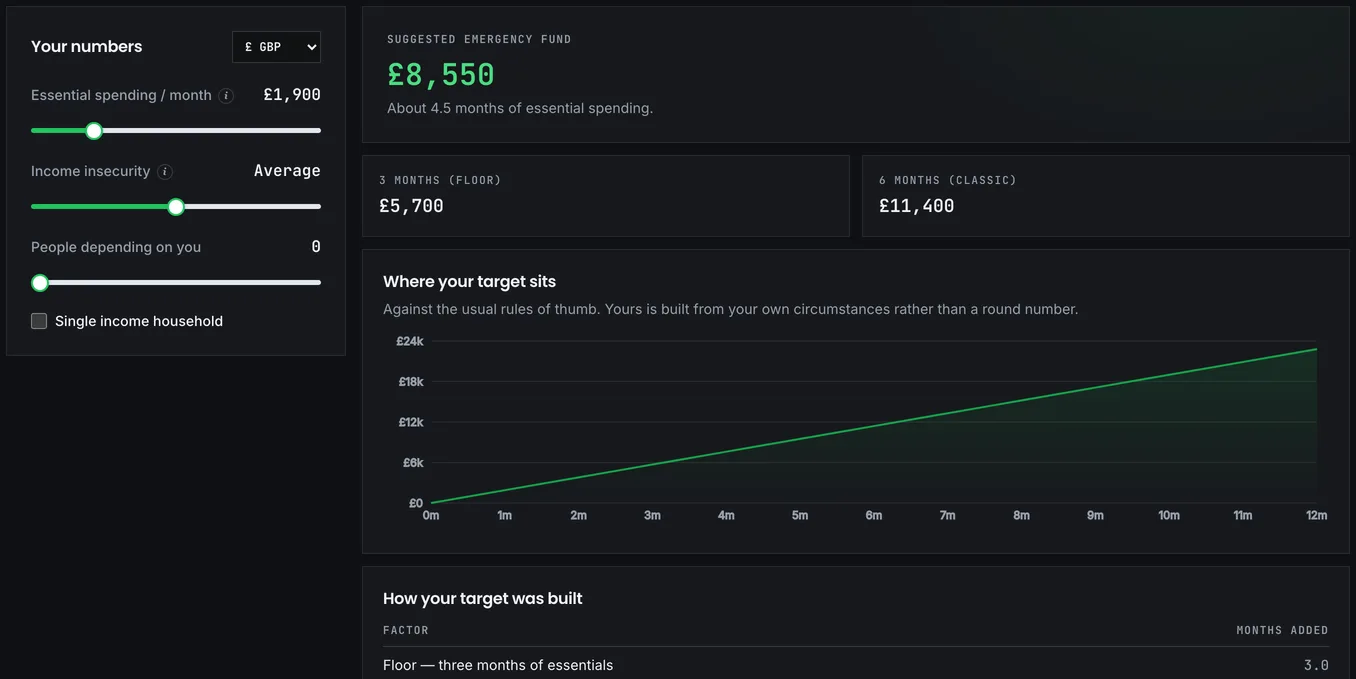
The calculator starts from a floor of three months of essentials, then adds cover for the risk factors you set: how secure your income is, how many people depend on it, and whether yours is the only one coming in. Behind those toggles sits one variable: how long your household could go without its main income. Not which disaster you find easiest to picture. The dramatic scenarios people imagine are rarely the ones that arrive; the income gap is.
Three months suits a stable salaried job in a field that hires steadily, no dependants, and a partner who also earns. Six is the common default and a reasonable place for most people to land. Nine to twelve fits anyone whose income is irregular or whose role takes a long time to replace, and that group is bigger than it sounds: self-employed and freelance, commission-heavy pay, contract work, senior or specialised positions, sole earners for a household, anyone with a health condition that could interrupt work.
Then adjust the answer twice, for two things the tool does not ask about. Homeowners should lean higher than renters at the same income, because a landlord's boiler is the landlord's problem and yours is not; property throws up four-figure bills with no notice. And your contract matters as much as your job title. Six months of contractual sick pay is itself a buffer, while statutory sick pay alone, at its current level, will not cover a mortgage. Read your terms before you pick the number.
A boring account, on purpose
Where the money lives has three requirements, in order: reachable within a day or two, not exposed to markets, and earning what it can. In that order, because the first two are the job and the third is a bonus.
An instant-access savings account with a UK-authorised bank is the standard answer, not least because the balance is covered by FSCS deposit protection if the bank itself fails. A cash ISA works if you have allowance spare, and premium bonds are acceptable for part of it, since withdrawal takes a few days. What fails the test is more instructive. Not a current account, where the money becomes indistinguishable from spending money and quietly disappears. Not stocks and shares, because the moment you need it is disproportionately likely to be a moment markets are down; redundancies and crashes arrive together, which is the cruellest correlation in personal finance. Not a fixed-term account you cannot break.
Keep it visibly separate from everything else, and give the account a name that makes raiding it feel like a decision.
One month first
Six months of essentials is a large number, and staring at it is how people never start.
So don't. Get to one month. That single month converts most minor emergencies from a debt event into an inconvenience, and it is achievable in a way the full target is not.
Then build the rest alongside your other goals rather than after them. Keep taking the employer pension match throughout; it is free money, and pausing it to build cash faster is a bad trade. Clear genuinely expensive debt in parallel too, because a 24% card is costing more than the fund is protecting. The payday allocator splits each month's income across the fund and everything else, and the savings goal calculator turns the target into a monthly figure and a date, which is the form a goal needs to be in before it happens.
The word "technically"
The fund only works if the definition holds, and the definition erodes quietly.
An emergency is unexpected, necessary and urgent. All three. Losing your job qualifies on every count, and so does that November boiler, and so does a car repair you need to get to work. A holiday you booked six months ago qualifies on none of them. Christmas is not unexpected; it arrives on the same date annually. A car service is not unexpected either, it is scheduled maintenance you knew about. Neither belongs here.
The tell is the word "technically". If you find yourself explaining why something technically qualifies, it does not. Known future costs belong in their own pots, which is precisely what sinking funds are for, and keeping them separate is what stops the emergency fund being permanently half-empty when something genuinely unexpected happens. The fund is not a house deposit, a car fund or an opportunity fund either; those are sinking funds too, just larger ones. Two grey areas are worth settling in advance rather than in the moment: dental and medical costs are usually genuine emergencies, while helping family is a real obligation for many people but an unlimited one, so have a figure in mind before the call comes.
When you do spend from it, that is the system working. Using the fund is a success, not a failure; refilling it simply becomes the priority again afterwards. Review the target once a year as well, because essentials rise, particularly housing and energy, and a fund sized three years ago probably covers fewer months than it says on the tin.
And then, once it is full, stop. Beyond your chosen number, extra cash is losing to inflation, and the money is better directed at debt or investments. At that point the FIRE calculator becomes the more interesting tool, because you have built the base that makes long-term plans survivable.