
A 1% annual charge sounds like it should cost you 1%. It does not. It costs roughly a fifth of your growth, every year, compounding, because it comes out of a return that might only be 5% in real terms.
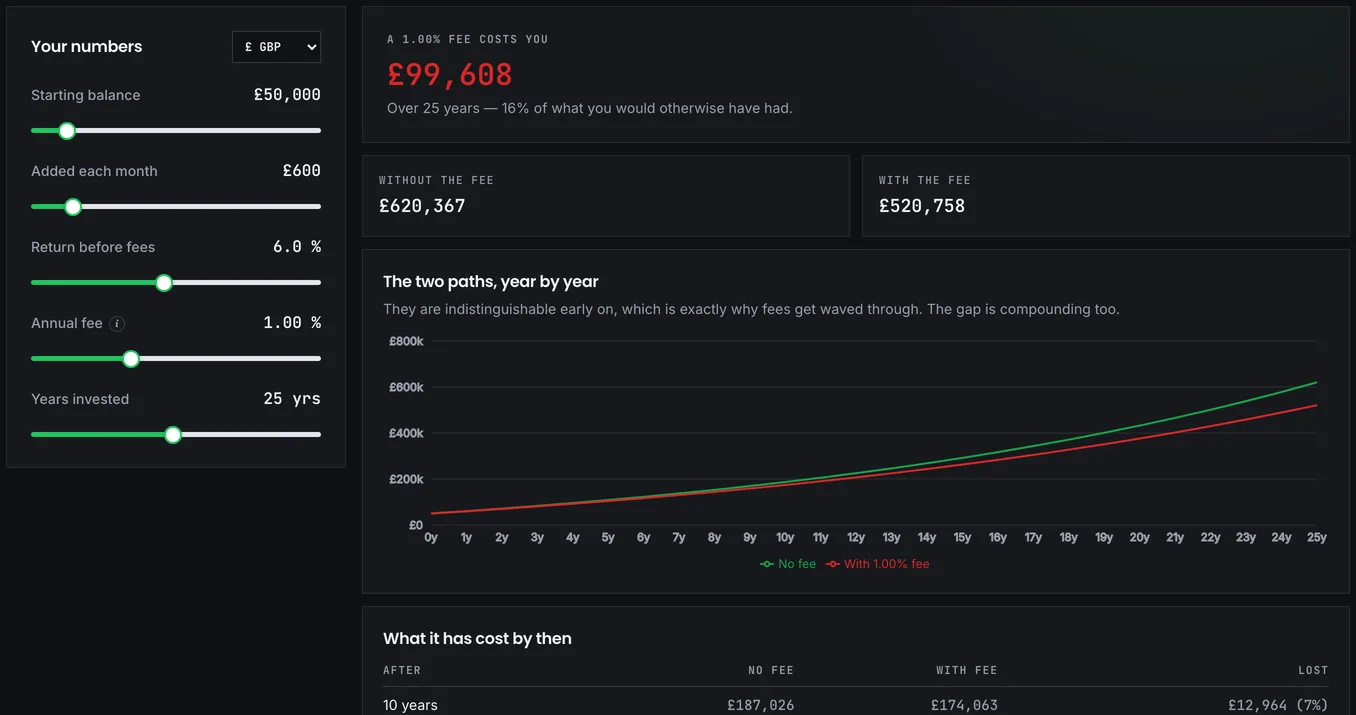
The fee impact calculator shows what that becomes over an investing lifetime, and the figure is usually larger than people are prepared for.
Four layers that never appear on one statement
Most people underestimate what they pay, and the reason is structural: charges arrive in layers and nothing adds them up for you.
The platform or provider fee is what the company holding your account charges, commonly 0.15% to 0.45% a year, sometimes capped, sometimes a flat annual amount. The fund charge, the OCF, is what the fund itself takes: global index trackers sit around 0.10% to 0.25%, while actively managed funds frequently run 0.75% to 1.0% or more. Transaction costs are disclosed separately and easy to miss, usually small for index funds and larger for funds that trade actively. And if you have an adviser, their fee is often 0.5% to 1.0% a year, on top of everything above.
Add the layers together, because that total is what goes into the calculator. For someone in an actively managed fund on a platform with an adviser, an all-in figure north of 2% is entirely normal, and it is rarely presented as a single number anywhere.
What one percentage point took
Enter a starting amount, a monthly contribution, an expected return, a horizon and the annual charge, and the tool projects the same plan with and without that charge and shows the gap. To compare two arrangements rather than a charge against nothing, enter the return net of the cheaper charge and put the difference between the two in the fee box. The gap in pounds is the number to stare at, not the percentage. Watch how it widens, too: the difference is small for the first decade and then accelerates, because the fee is charged on a balance that keeps growing, and the money removed early would otherwise have been compounding for the entire remaining period. The true cost of a fee is not what it takes. It is what it takes plus everything that money would have gone on to earn.
Here is a run worth copying. Start with £20,000, add £300 a month for 35 years, and compare an all-in charge of 0.2%, a low-cost index fund on a cheap platform, against 1.2%, an actively managed fund on a mainstream platform, assuming 5% real growth before charges. In the tool that means a return of 4.8%, the growth net of the cheaper charge, with 1% in the fee box for the difference. The cheap arrangement reaches £422,000; the expensive one reaches roughly £333,000.
The gap is £89,000, which is 21% of the larger figure. You contributed £146,000 over those 35 years, so the difference in charges cost about three fifths of everything you paid in. Nothing else changed. Same contributions, same market, same discipline for three and a half decades, and one percentage point of annual charge took £89,000.
And that is a comparatively modest pairing. Try 1% against 0.2% yourself, roughly the distance between a typical active arrangement and a low-cost index approach, and over a full working life the gap comes to about a fifth of the final pot. Someone paying 2% all-in, which an adviser plus an active fund plus a platform reaches easily, loses roughly twice that: around two fifths of everything over a full career.
Percentages keep this abstract; time makes it concrete. Over 30 to 40 years, each percentage point of annual charge removes something in the region of a fifth to a quarter of what you would otherwise have, and a pot reduced by a quarter takes several more years of contributions to rebuild. A high-charging arrangement does not simply cost money. It costs the years of working needed to replace that money, and running both figures through the FIRE calculator converts the gap into an actual delay to your retirement date, which is the version that tends to prompt action.
A fee is the one variable in investing that is guaranteed, known in advance and entirely within your control. Returns are none of those three things. That mismatch is why fees deserve far more of your attention than they usually get.
When 0.75% is money well spent
Not every fee is waste, and the calculator has no opinion on value. Someone who would otherwise panic-sell in a crash, or make a serious tax error, may well be better off net of a 0.75% adviser fee, because behaviour destroys more wealth than charges do. If you do pay for advice, know exactly what you are paying for it, and the FCA's consumer pages are the place to check an adviser before handing over anything. Workplace pensions often carry a limited fund menu, and there the employer match dwarfs any charge difference, so take the match regardless of the fees. Small balances change the sums as well: flat-fee platforms are poor value on small pots and excellent on large ones, percentage fees the reverse, so which is cheaper depends on your balance and flips as the balance grows.
What is not defensible is paying active management charges for a fund that closely tracks its index anyway. That arrangement is common, expensive, and shows up clearly the moment you compare a fund's holdings against the index it is measured against.
A pay rise you give yourself
Start by finding out what you are actually paying, which almost nobody does. Statements disclose it; the figure is rarely prominent. Then compare platforms on your real balance rather than in the abstract, because the cheapest provider at £20,000 is frequently not the cheapest at £200,000. Old pensions deserve a look too. They often sit in legacy schemes with charges well above anything currently sold, though check for guaranteed benefits or exit penalties before moving anything. And use index funds wherever you have the choice.
A reduction from 1.2% to 0.3% is functionally a permanent return increase of 0.9% a year, available immediately, with no additional risk taken on. Very little else in investing offers that.
Once you know your real figure, feed it into your other assumptions. The compound interest calculator shows what the improved net return does to a lifetime of contributions, and the safe withdrawal rate tool explains why fees quietly consume the margin that rule depends on. Of everything you can change about your investing, this is the one with a guaranteed payoff.