
No line on any statement. No charge, no deduction, no falling balance. Inflation is the quietest force in personal finance because the number in your account never moves; what moves is what that number will buy.
The inflation calculator makes the change visible. Enter an amount, a rate and a number of years, and it reports what that sum will be worth in today's terms, or what you would need in future to match today's purchasing power.
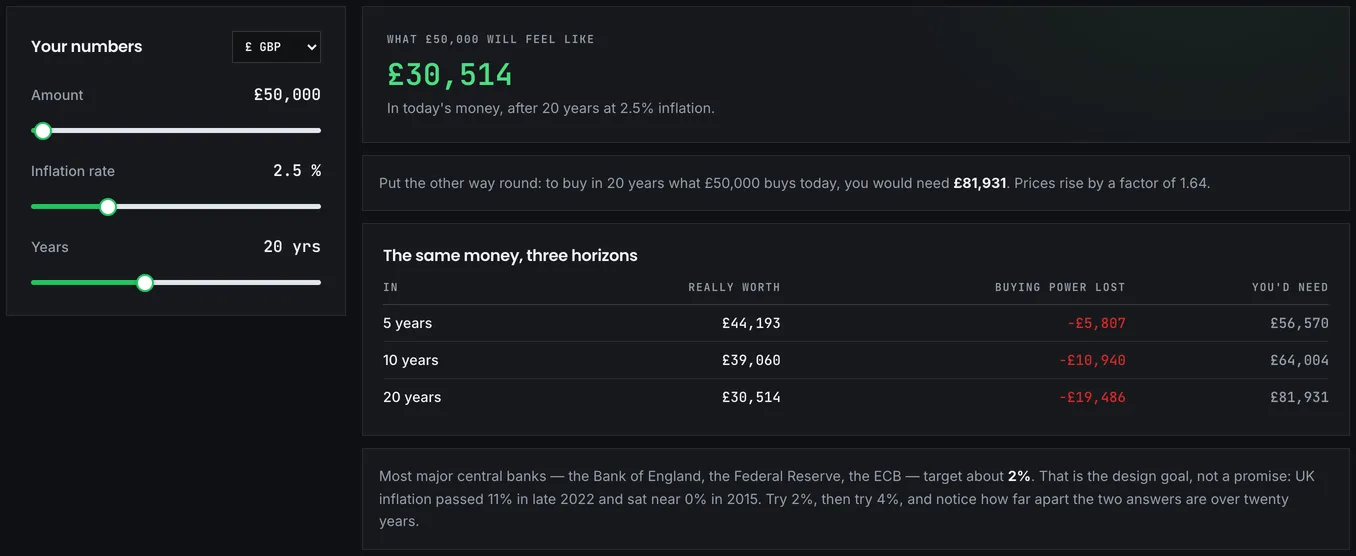
At the Bank of England's 2% target, money loses roughly a fifth of its value over ten years and around a third over twenty. At 3%, closer to a quarter over ten and nearly half over twenty. The UK has spent long stretches above both, and the 1970s reached levels that destroyed the value of fixed sums within a few years.
The unit-mixing mistake
The single most common error in long-term planning is mixing units: a nominal return against a target expressed in today's money.
Say you decide £700,000 will be a comfortable retirement pot, then project at 8% because that is the long-run nominal figure quoted for equities. Thirty years later you have your £700,000, and it buys roughly what £290,000 buys now at 3% inflation. The plan was never wrong arithmetically. It was answering a different question from the one you asked.
Two ways to avoid it, and only one is easy. You can work entirely in today's money, using a real return (nominal minus inflation) and reading every output as current purchasing power. This is the approach every calculator on this site takes, and it is why the FIRE tools ask for a real return rather than a nominal one. Or you can work entirely in future money: a nominal return and an inflated target. Consistent, correct, and much harder to reason about, because nobody has any intuition for what £1.7m will feel like in 2056.
Pick one basis and never mix them. Almost every wildly optimistic retirement projection you will ever see is a nominal return applied to a target set in today's prices.
Where the erosion does real damage
Cash takes it first. A savings account paying below the inflation rate is losing value in real terms with complete reliability, which is acceptable for an emergency fund, where availability is the whole point, and corrosive for money left there for a decade.
Fixed pensions take it hardest. A defined-benefit pension without inflation linking, or an annuity bought on a level basis, pays the same amount for life, and after twenty years at 3% that income buys about 55% of what it did at the start. This is one of the most underappreciated risks in retirement, precisely because the number on the payslip never changes.
Long-dated goals are quietly exposed too: university costs, a house deposit fifteen years out, a target retirement income. All of these need stating in today's money and inflating, or they will come up short without anyone noticing when. Even your salary is in the game. A pay rise below inflation is a pay cut, and several consecutive years of it is how real incomes fall without anyone receiving bad news.
Not everything erodes, though, and the exceptions are worth knowing. Equities resist it over long periods, because companies raise prices too; not reliably in any given year, since shares often fall when inflation spikes, but over decades they have been the most dependable protection available. The state pension has its own uprating arrangements, and index-linked gilts adjust with prices by design. Property tracks it imperfectly: rents and values have broadly followed inflation over long periods, with enormous regional variation and none of the guarantees. And a mortgage, interestingly, benefits. The debt is a fixed nominal amount, so rising prices and wages erode its real size, which is a genuine and rarely mentioned argument on the other side of the mortgage overpayment question.
A thousand pounds, twenty years on
At 3% a year, a little above the Bank of England's target and close to the long-run UK average, £1,000 today is worth about £744 after ten years and about £554 after twenty. So a fixed income of £20,000 buys around £11,000 of today's goods by year twenty. That is the annuity problem stated plainly.
Shorter and sharper: at 7.5%, close to what UK inflation averaged across 2023, £1,000 falls to about £697 in only five years. Sustained high inflation does in half a decade what moderate inflation takes twenty years to achieve.
For historical context, UK inflation has spent most of the past thirty years between 1% and 4%, with a long calm stretch after the mid-1990s that made it easy to ignore. The 1970s were an entirely different environment, with several years in double digits and a peak above 20%. Anyone planning a forty-year retirement is planning across a period long enough to contain both kinds of decade.
Two habits worth keeping
Convert historical figures before comparing them. "My parents bought this house for £48,000" is meaningless without adjusting, and so is a salary from fifteen years ago, or the cost of anything you remember being cheap. The Bank of England's own inflation calculator will do the historical conversion for you from actual UK price data, which makes it the fastest way to settle any argument that starts with "back in my day".
And sanity-check every long projection. If a number came from a calculator that didn't ask about inflation, find out which basis it used before believing it. A tool that quotes an impressive figure thirty years out without ever mentioning inflation is not necessarily wrong, but it is leaving the most important adjustment to you.
For everything else on this site the work is already done: real returns go in, today's money comes out. The compound interest calculator covers why a single percentage point matters so much over decades, and the FIRE calculator builds a whole retirement plan on that same real-terms basis, which is what makes its output a figure you can actually reason about.
The habit worth taking from this tool is small and permanent: whenever you meet a large number attached to a distant date, ask which money it is denominated in. That one question catches most of the over-optimistic planning you will ever encounter, including your own.