
A plan that reaches its number at 52 with most of the money inside a pension is not a plan to stop at 52. It's a plan to stop at 57, with a very comfortable five years of waiting first.
The pension bridge calculator exists for exactly this problem: it works out whether the money you can actually reach covers the gap between the day you stop earning and the day your pension opens.
Three retirements, not one
UK pensions cannot normally be touched before age 55, rising to 57 from April 2028; the change is set out in the government's paper on the normal minimum pension age. There's talk of the age tracking ten years below state pension age thereafter, which would push it further out for younger savers. The state pension itself arrives later still: currently 66, rising to 67, with 68 already legislated, and GOV.UK will tell you your own date.
So an early retirement actually has up to three phases. First the bridge, from stopping work until pension access, funded entirely by ISAs, general investment accounts and cash. Then pension drawdown, from access age until the state pension arrives. Then full retirement, with everything flowing at once, state pension included.
Almost every FIRE projection models all of this as a single pot drawn evenly. Fine for the total; useless for the question of whether you can actually stop when the projection says you can.
Seven years of spending, somewhere you can reach it
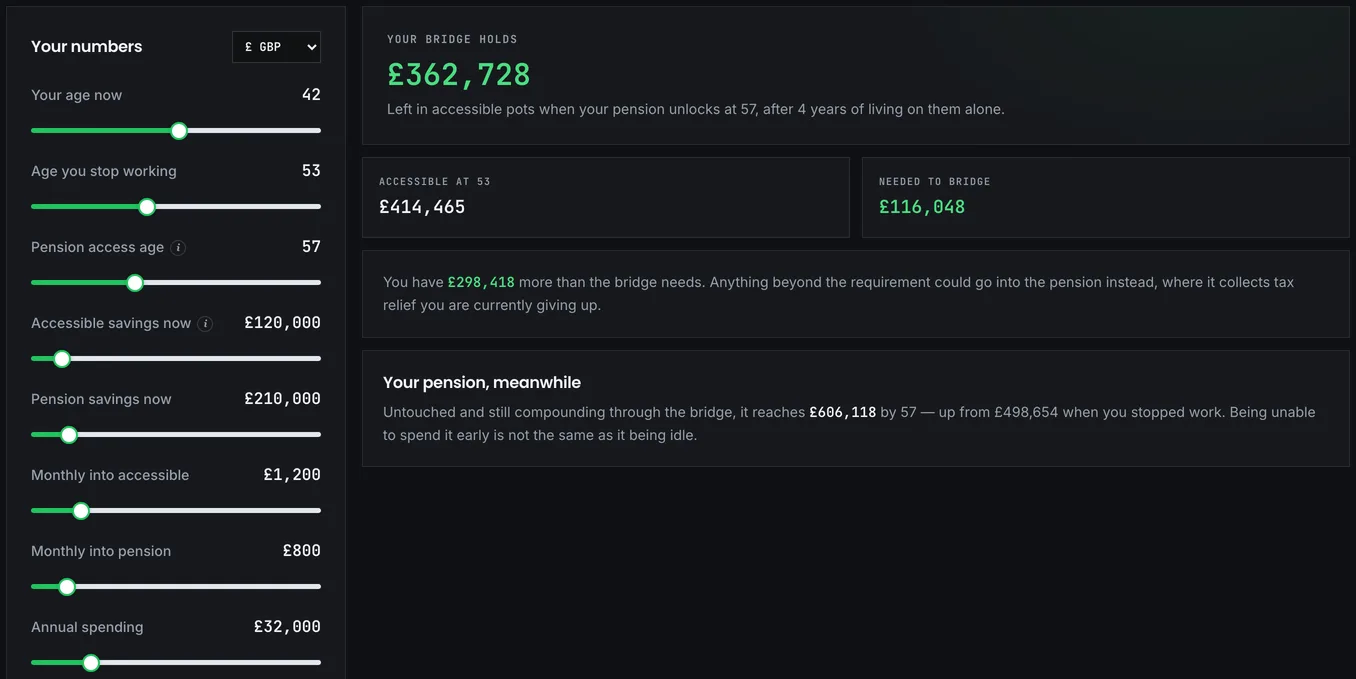
The tool asks for your ages (now, stopping, and pension access), your pot and monthly contribution on each side of the wall, accessible and locked, plus your spending and expected return. It grows both pots until you stop, then drains the accessible one across the bridge while the pension compounds untouched. The headline is blunt: your bridge holds, with what's left when the pension opens, or your bridge breaks, with the age the accessible money runs out. Underneath, it reports what the bridge actually requires at the moment you stop, compared against what you'll have.
For a rough sense of scale, someone stopping at 50 with access at 57 needs seven years of spending accessible. At £30,000 a year that's around £210,000. Less in practice, because the bridge pot keeps growing while it's being drawn, but the order of magnitude is right, and the order of magnitude is the shock. That's a substantial sum, and it has to be in the right wrapper. A £900,000 total with £820,000 of it in pensions fails this test badly, despite looking more than sufficient in any headline projection.
The question is never just "is the pot big enough". It's "is the pot big enough, and reachable when I need it", and plenty of plans pass the first test while failing the second without anyone noticing until it's late.
The relief that locks the door
Once you can see the bridge, the practical decision it informs is where each month's money should go, and it's a genuine trade-off rather than an obvious answer.
Pensions win on tax, and it isn't close. Contributions come from pre-tax income, so a higher-rate taxpayer gets 40% relief immediately, and salary sacrifice adds National Insurance savings on top. Nothing an ISA offers competes with that. What ISAs win on is access: £20,000 a year each, no tax on growth or withdrawal, available at any age for any reason. And an employer match beats both, always, and should be taken in full before this question even arises.
The sensible shape for most early retirees follows from those three facts. Take the full match. Build the bridge in ISAs until it covers the gap. Then direct everything beyond that back into the pension for the relief.
Getting it backwards, maximising pension contributions for the relief and arriving at 50 with nothing accessible, is the single most common structural mistake in UK early retirement planning. The relief was real. It bought you a retirement you can't start.
What shortens the span
The bridge doesn't have to be carried by savings alone, and most people who face a long one don't carry it that way.
Part-time work during the gap reduces what the bridge must fund, and the effect is considerable, because every £1 earned is £1 the pot doesn't have to produce during its most vulnerable years. This is Barista FIRE, and it's the most common way people handle a long bridge in practice. A partner with a different age helps too: if one of you reaches access age sooner, their pension can carry part of the household through the tail of the other's bridge, and the couples FIRE calculator handles two sets of ages properly.
A defined-benefit pension changes the picture as well, since these often have their own scheme rules and earlier normal pension ages, though taking one early usually carries a permanent reduction. And the Lifetime ISA deserves a careful mention. Contributions attract a 25% bonus, but the money can't come out before 60 without a penalty that removes more than the bonus gave. That makes a LISA a poor bridge instrument for anyone stopping in their early fifties and a perfectly reasonable one for a later gap.
£2,000 a month, split two ways
Someone is 40, wants to stop at 52, and will reach pension access at 57. Five bridge years at £28,000 is roughly £140,000 needed outside a pension.
They can invest £2,000 a month. The naive split, everything into the pension for the 40% relief, builds an excellent pension and leaves them unable to stop until 57. The deliberate split works better: around £900 a month to an ISA for twelve years and, with growth, the bridge is comfortably covered by 52, while the remaining £1,100 goes into the pension and still captures relief on the larger share.
Yes, the pension ends up smaller than it would have been. It also ends up sufficient, because it now only has to fund from 57 onward rather than from 52. Five fewer years, with the state pension arriving partway through.
The general rule falls out of the example: work out the bridge first, fund it, then optimise everything above it for tax. Not the other way round.
Before you lean your weight on it
Check your actual pension access age rather than assuming 57. It depends on your date of birth, and on any protected pension age you may hold from an older scheme.
Check whether the bridge pot is invested appropriately for its timeline. Money needed in three years should not sit entirely in equities; money needed in twelve years probably should. A bridge spanning seven years is really a series of shorter goals wearing one name, and it deserves to be invested that way.
And check tax on the way out. Drawing from a pension is taxable income beyond the 25% tax-free element; drawing from an ISA is not. That difference is worth planning around, and it can make a smaller total pot go further than a larger, worse-arranged one.
Once the bridge holds, take the whole plan back to the FIRE calculator for the overall picture, then run it through the Monte Carlo simulator. A bridge drawn down hard in its first years is exactly the shape that sequence risk punishes most.