
Averages are reassuring. That is exactly the problem with them.
Most retirement plans are tested against average returns and pass comfortably, which tells you very little about the scenario that actually breaks plans. The retirement crash test asks one blunt question instead: what if the market falls hard in the exact year you stop earning? It applies a 35% fall at retirement and then runs the plan forward normally. No prolonged crisis, no repeated shocks. One bad year, at the worst possible moment.
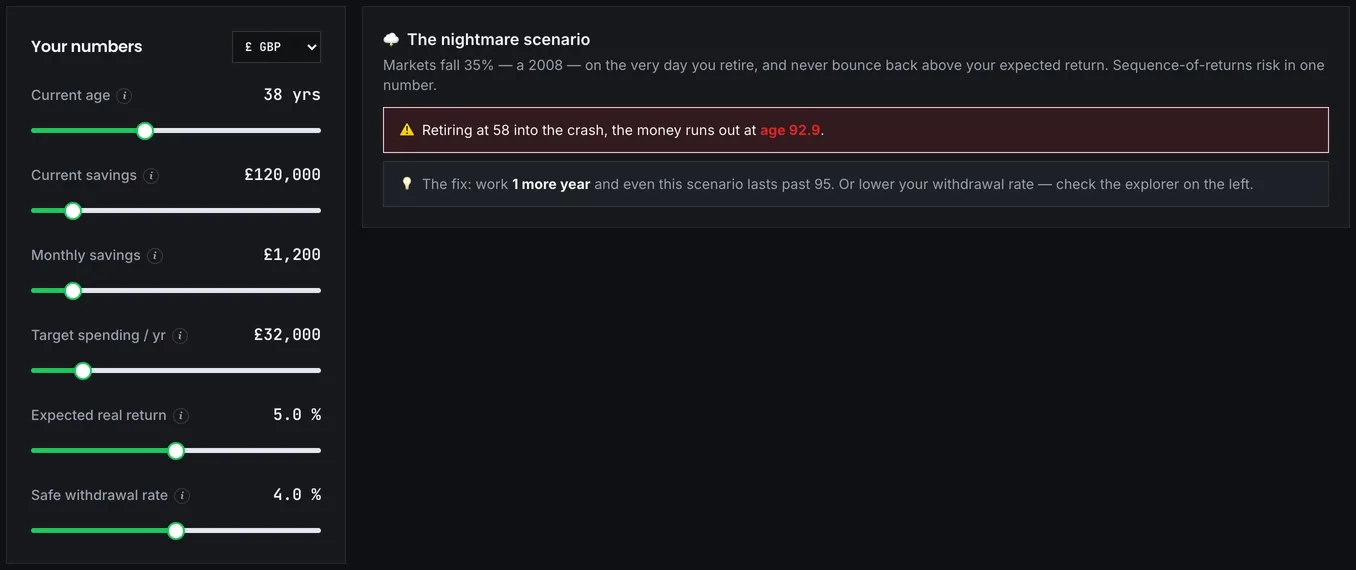
The month you start selling
A 35% fall at 40, while you are still working, is close to irrelevant. You are not selling anything, you keep buying at lower prices, and you have decades for the recovery. Historically these have been the best buying opportunities of an investing life.
The identical fall the month you retire is a different event entirely, for one reason: you have started selling. Every withdrawal now takes a larger slice of a smaller pot. Units sold at the bottom are gone permanently; they do not participate in the recovery. So the portfolio has to climb back not from where it fell, but from where it fell minus everything you spent while it was down there.
This is sequence risk expressed as a single event, and it is why two retirees with identical average returns over thirty years can end up in completely different positions. The average was never the danger. The order was.
Runs out at 81
The tool reports whether the plan survives, and if not, when it fails.
"Runs out at age 81" is the kind of answer that reframes a plan, because nothing in the assumptions was reckless. It was one badly timed year. "Survives past 95" means your plan has genuine margin, and 95 is a sensible age to demand it to, given what ONS life expectancy figures say about how long a retirement can run. That margin came from somewhere specific: a conservative withdrawal rate, a later retirement age, or income that is not the portfolio.
The most actionable figure is "extra years needed", which tells you how much longer you would have to work for the plan to survive the shock. Two extra years is a manageable insurance premium. Nine means the plan is fragile in a way that needs addressing before you act on it, because a plan that only works if markets behave in your first decade is not really a plan at all. It is a bet, with your retirement as the stake.
The cheap fix and the expensive ones
Four things move the result, and they are not equally priced.
Spending flexibility is by far the cheapest. Cutting withdrawals by 10% for the two or three years after a crash rescues a large share of otherwise failing plans, because it stops you liquidating at the bottom, and it costs you almost nothing in every scenario where the crash never comes. If you take one thing from this tool, take that. The withdrawal strategies tool models the rules that make the cut automatic rather than a decision you have to make while frightened.
A cash buffer does the same job differently: two or three years of spending held in cash means the first bad years are funded without selling any investments at all. It costs you the returns that cash does not earn, which over a long retirement is real money, but it directly targets the specific mechanism that does the damage. Working slightly longer helps twice over, a bigger pot and fewer years to fund, which is why the extra-years figure is usually smaller than people fear. And a lower withdrawal rate is the blunt instrument: effective, but it means a larger target pot and a later finish. The safe withdrawal rate tool shows what your rate implies.
Notice what is not on the list: switching your allocation to something more cautious. Holding more bonds softens the fall but weakens the growth the following decades depend on, and in long retirements that trade frequently makes the plan worse rather than better.
35% is not a horror story
The shock is deliberately severe without being fanciful, and recent history backs it. The S&P 500 lost roughly 37% over calendar 2008, and around 57% from its 2007 peak to the 2009 trough. The dot-com unwind took it down about 49% between 2000 and 2002. In early 2020 markets fell roughly a third in under five weeks, and UK investors saw considerably worse in 1973–74.
So a 35% single-year fall is not a tail scenario invented to frighten you. It is something a diversified equity investor should expect to meet several times across a long investing life, and at least once with reasonable probability during the decade around their retirement. What makes it survivable at 40 and dangerous at 65 is not the size of the fall; it is entirely whether you are buying or selling when it happens.
What history also shows, though, is that this test simplifies in two directions. It models one shock at one moment, while real bad periods are usually longer and less dramatic: a decade of flat real returns with high inflation does more damage than a single sharp fall, and that slower pattern is what broke the worst historical cohorts. The retirement backtest is where you see those. It also assumes a recovery afterwards at your expected return, which is what markets have historically done, but that assumption is doing real work in the result. And it lands the crash precisely at retirement, while a fall three years in is less severe but still serious; the Monte Carlo simulator covers the whole distribution of when a shock might arrive rather than this single worst case.
The second tool you run
Build the plan in the FIRE calculator first. Come here second, because this is the fastest single check of whether the plan can take a hit: one number, one question, an answer in seconds. If it survives, run the Monte Carlo simulator for the fuller picture. If it fails, the extra-years figure tells you exactly what the fix costs before you decide whether to pay it.
One last thing worth saying plainly. A failed crash test is not a reason to abandon early retirement, and it is not a verdict on your saving. It is the plan telling you, years in advance and for free, exactly which assumption it is leaning on hardest, which is the most valuable thing any projection can do. Far better to discover it now, while working eighteen more months or agreeing a spending rule is still an easy option, than at 68 with the pot half gone and no way back into the job market.